Bluesign & GRS Webbing Sourcing: A Buyer's Compliance Guide
Bluesign & GRS Webbing Sourcing: A Buyer's Compliance Guide
Outdoor gear brands sourcing eco-friendly webbing now receive two documents from almost every credible supplier: a Bluesign System Partner confirmation and a Global Recycled Standard (GRS) certificate. Both matter. Neither explains itself. Bluesign speaks to how a mill controls input chemistry across its processes. GRS speaks to where recycled material came from and whether that custody can be traced to your shipment. Confusing the two is one of the most common reasons a sustainability claim fails an internal review or a retail audit.
This guide is written for sourcing managers, product developers, and sustainability leads evaluating webbing for outdoor programmes. It covers what each credential actually certifies, how to verify it against a specific purchase order, and what evidence to collect before production begins.
Why certification claims stall at the audit stage
Most sustainability failures in webbing sourcing are documentary rather than technical. The fibre is sound, the strength is sound, the colour is sound, but the paperwork does not line up with the claim being made. Three patterns account for most of it.
- Scope mismatch. A GRS certificate covers named processes. If the webbing is dyed or finished at a site that is not listed on the certificate, the recycled claim does not travel with the goods. The scope line matters more than the certificate number.
- The missing Transaction Certificate. GRS recycled content is verified per shipment through a Transaction Certificate (TC). A mill-level certificate proves the system is certified; a TC proves that your specific order carried the recycled content. Brands that skip this cannot substantiate the percentage they print on a hangtag.
- The interchangeable-credential assumption. Bluesign and GRS answer different questions. A Bluesign System Partner is not automatically producing recycled webbing, and a GRS-certified line is not automatically screened against a full restricted substance list for input chemistry. Assuming one implies the other usually surfaces as a gap during a customer audit.
The practical fix is procedural: separate the compliance claim from the performance specification, and verify each one against its own evidence.
What the market is asking for now
Certified webbing has moved from a premium option to a baseline expectation in outdoor programmes. Grand View Research values the global webbing market at USD 4.2 billion in 2023, projected to reach USD 5.7 billion by 2030, with outdoor recreation a significant demand driver. Asia Pacific accounted for a 66.3% revenue share in 2023 on the strength of manufacturing infrastructure in countries including China and Vietnam.
The recycled-content shift is equally visible. Recycled polyester (rPET) accounted for roughly 15–18% of global polyester fibre production in 2024, according to Textile Exchange data reported by Szoneier Fabrics. Within materials, IMARC Group identifies nylon webbing as the fastest-growing segment in sporting goods because of its strength-to-weight ratio and elasticity, while polyester webbing remains the workhorse of leisure applications, used in roughly 60% of US leisure products.
For buyers, the implication is straightforward: recycled content alone no longer differentiates a programme. The differentiator has moved to documentation quality — whether the recycled percentage, the chemistry screening, and the performance specification can each be evidenced on request. Industry coverage from IMARC Group lists National Webbing Products Co., American Cord & Webbing Co. (ACW) and Murdock Webbing Company among leading global manufacturers in the sector, which is why brands increasingly compare suppliers on certification scope rather than on brand recognition alone.
The two credentials, defined
Bluesign System Partner: process and input chemistry
Bluesign is awarded at the production-system level. It assesses how a mill manages chemicals, water and emissions across its manufacturing chain against a restricted substance list that governs what may enter the process. It is not an article-level claim, and it is not a recycled-content claim.
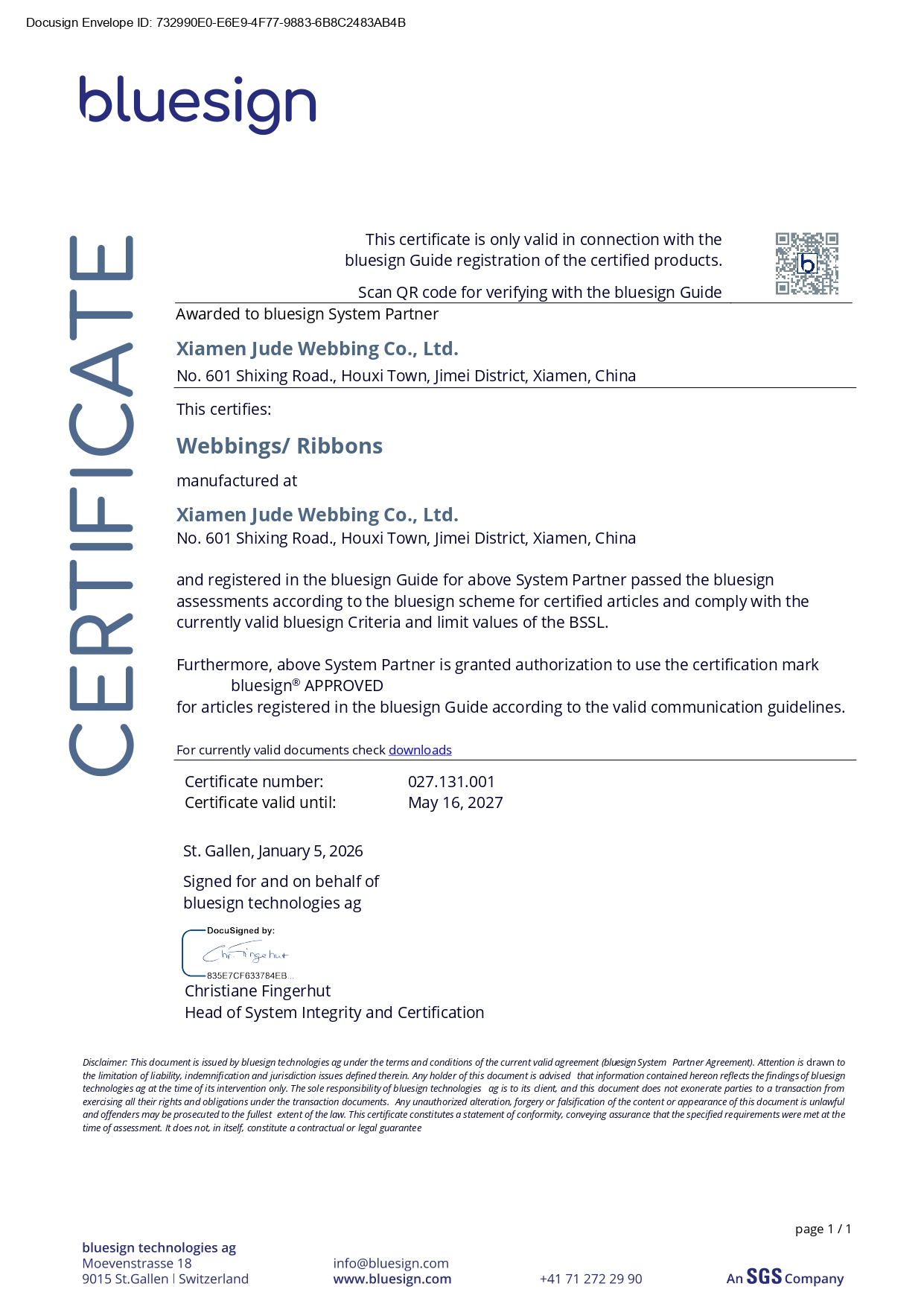
Xiamen Jude Webbing Co., Ltd., the manufacturer behind the JUDECAM brand, holds Bluesign System Partner status under certificate 027.131.001, granted by bluesign technologies ag for the scope Webbings / Ribbons. For a buyer, this answers one specific question: is this mill keeping unwanted chemistry out of the process?
The Bluesign Webbing product line carries a matching chemical safety profile — zero restricted substances per the Bluesign RSL — alongside colour fastness of ISO 105 Grade 4–5, perspiration Grade 4, and UV resistance of Grade 4 under BS EN ISO 105-B02. It is built on Bluesign System Partner nylon or polyester.
GRS 4.0: recycled content and chain of custody
GRS does the opposite job. It verifies that recycled material entered the product and that custody of that material can be traced through the supply chain.
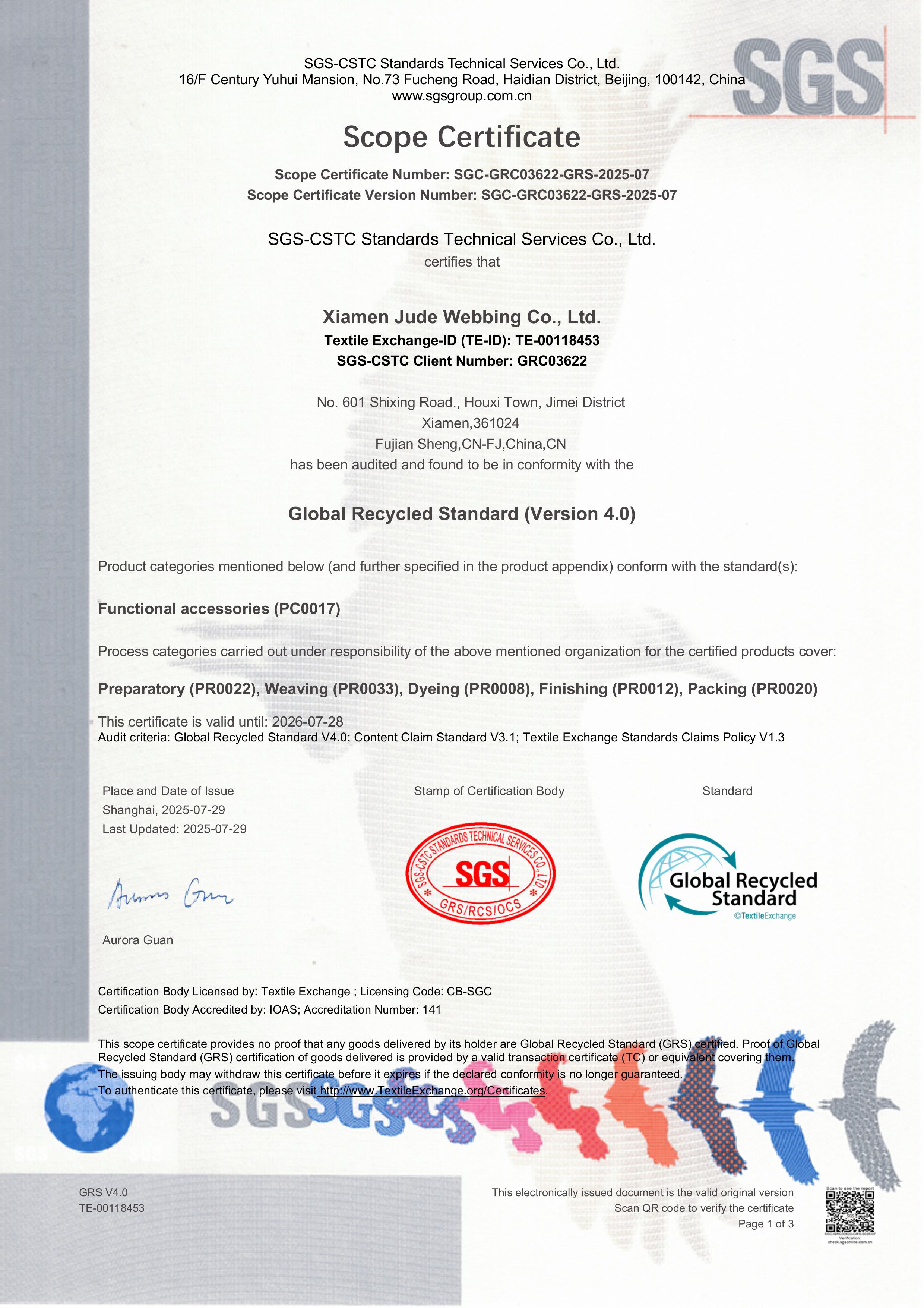
Jude Webbing's Global Recycled Standard certificate, reference SGC-GRC03622-GRS-2025-07, was issued by SGS and covers Preparatory (PR0022), Weaving (PR0033), Dyeing (PR0008), Finishing (PR0012) and Packing (PR0020). It is issued against Global Recycled Standard V4.0, Content Claim Standard V3.1, and the Textile Exchange Standards Claims Policy V1.3.
Two details matter commercially. First, the scope covers the production chain in-house — preparation, weaving, dyeing, finishing and packing — which is what allows a recycled claim to survive intact from yarn to roll. Second, GRS Webbing is supplied with recycled content of 50% to 100% verified by Transaction Certificate, supported by a documented chain of custody and colour fastness to washing of Grade 4–5 under ISO 105-C06. The base material is GRS 4.0 certified recycled polyester (RPET) or recycled nylon.
The supporting layer: OEKO-TEX, RSL, and management systems
Bluesign and GRS rarely sit alone in a brand's supplier file. The wider evidence stack at Jude Webbing includes:
- OEKO-TEX Standard 100 Class I (baby articles) certificate SH010273603.1, issued by TESTEX AG, for woven tape made of 100% polyester or 100% polyamide
- RSL certificate 1001380744 from UL, covering nonylphenol (NP) and octylphenol (OP) in textiles per EN ISO 21084
- AZO & PCP free test report C50472163 from UL
- ISO 9001:2015 (00224Q22797R0M), ISO 14001:2015 (00224E31944R0M) and ISO 45001:2018 (00224S21758R0M), issued by CQM for the design and processing of functional webbing and webbing-finished products
- Performance test reports from SGS: anti-UV (SL82108301587901TX, ISO 105), colour fastness (SL82108291350601TX, AATCC 186 and ISO 105), and breaking strength (SL82308280825301TX, PIA-Test Method-4108A-2005)
Together these cover the three questions a retail customer usually asks: is the chemistry controlled, is the recycled content traceable, and are the physical performance claims independently tested?
How to verify Bluesign and GRS webbing before you order
Step 1 — Define the claim before you define the specification
Write down the exact sentence that will appear on the hangtag, the brand website, or the retail submission. “Made with 50% recycled content” requires GRS documentation of at least that percentage. “Bluesign approved fabric” requires Bluesign system coverage of the relevant production site. “OEKO-TEX Class I” requires the specific article certificate. Once the claim is fixed, the document list writes itself, and the risk of collecting unnecessary paperwork disappears.
Step 2 — Request the certificate and read the scope line, not the logo
Ask for the full certificate, not a cropped image. On a GRS certificate, read the process list: preparatory, weaving, dyeing, finishing, packing. On a Bluesign confirmation, read the scope: Webbings / Ribbons. If your webbing passes through any stage that is not represented in that list, raise it before sampling rather than after inspection.
Step 3 — Match a Transaction Certificate to your shipment
Recycled content claims need per-shipment evidence. Request a TC for the production batch covering your order, and reconcile the recycled percentage stated on it against the percentage on your specification sheet. Because Jude Webbing's GRS scope runs from preparatory through packing, the chain of custody does not leave the certified system between yarn intake and roll packing — which is what makes a TC straightforward to issue.
Step 4 — Re-test the performance specification on the certified construction
Certification and performance are separate purchases. A certified webbing still has to meet the mechanical brief. For outdoor programmes, the properties worth confirming on the certified version are UV fastness (Grade 4.5 after 500 hours under ISO 105 for Polyester Webbing, and Grade 4.5 after 1000 hours for Backpack Webbing and Camping Webbing), water absorption (under 0.5% for polyester constructions), shrinkage (under 3% at 100°C for RPET Webbing), and colour fastness to light (Grade 4 under ISO 105-B02 for Nylon Outdoor Webbing).
Where the programme involves climbing or load-bearing safety components, the governing benchmark in the EU is EN 566, which specifies a minimum tensile strength of 22 kN for slings. Jude Webbing's Tubular Webbing is manufactured from 100% high-strength Polyamide 6.6 with a breaking-strength range of 15 kN to 25 kN, and has passed UIAA certification through a European testing agency via a brand customer's programme, with abrasion performance exceeding CE/UIAA standards. Buyers specifying for EU climbing use should confirm the specific construction against the 22 kN threshold rather than assuming it from a product family.
Step 5 — Lock MOQ, lead time and change control before tooling
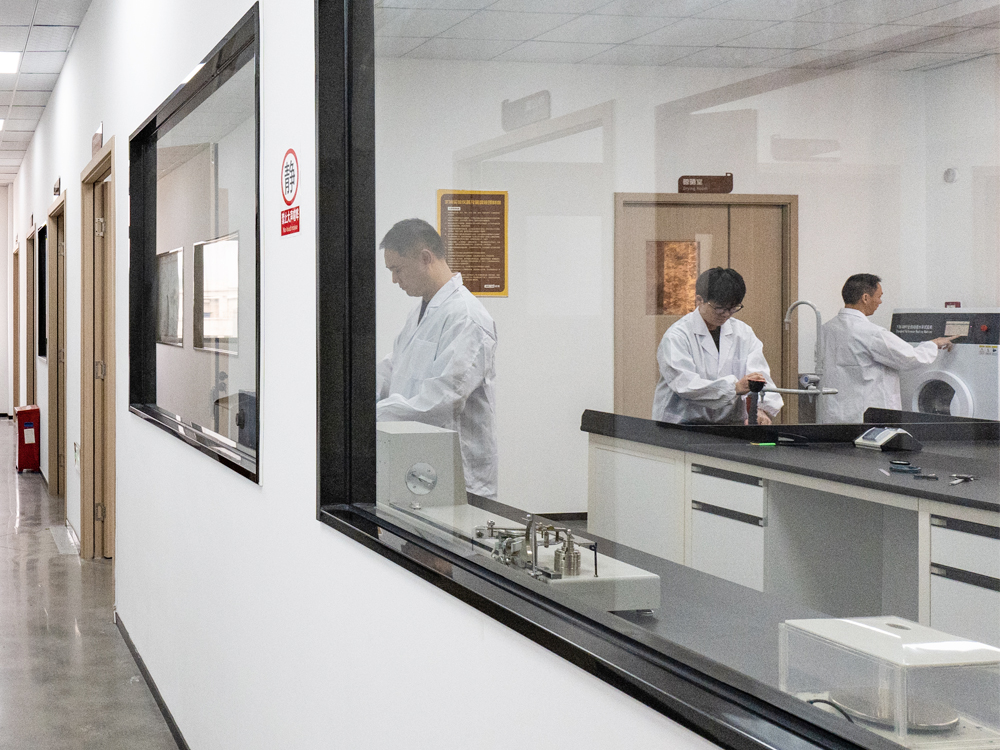
Certified programmes fail on logistics as often as on documents. Confirm volumes, sampling windows and change-control rules early. Jude Webbing operates a 25,800 m² production base across Xiamen and Vietnam with approximately 180 employees, 32 webbing specialists in R&D, and 300 million yards of annual output, with a monthly capacity of approximately 25,000,000 yards and a 100% quality check process covering durability, colour consistency and material inspection.
Where certified webbing is used, and what to specify
Modular backpacks and expandable carrying systems
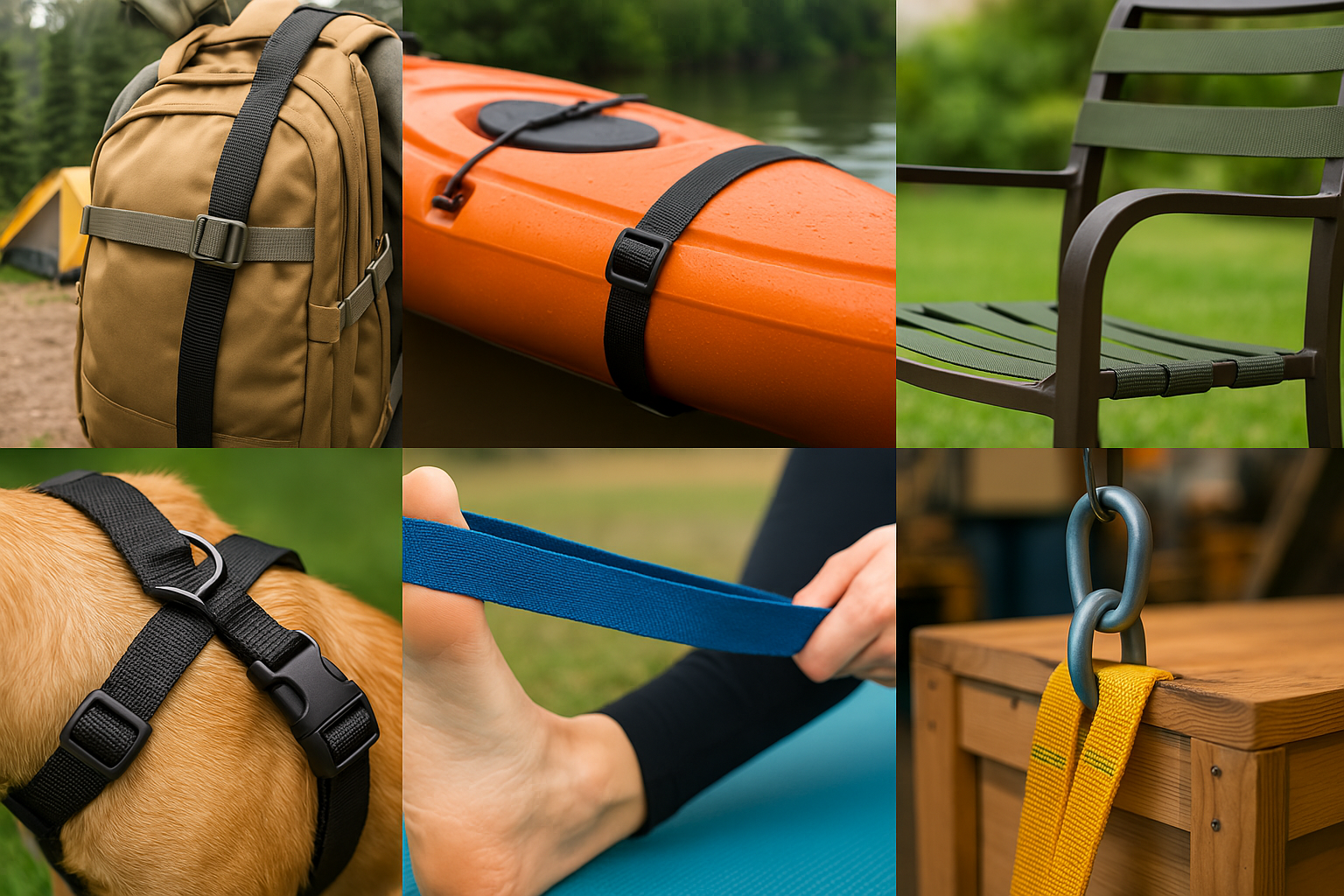
Backpack Webbing (product 3292) has been used by outdoor gear brand clients in modular backpacks, expandable carrying systems and outdoor gear accessories, with annual usage exceeding 300,000 metres and performance maintained for 2–3 years under regular outdoor use. Client programmes span multiple European countries, the US and Asia. Specification highlights include modular attachment compatibility, lightweight flexible design, durability under repeated use, and custom colour and pattern options, with edges finished by friction-free ultrasonic cut.
Luggage, cooler bags and travel gear
Recycled Webbing (product 3291) has been adopted by outdoor brand clients in Germany, Switzerland, Sweden, the United Kingdom, Finland, Poland, Estonia, the Netherlands, Vietnam, Malaysia and Norway, with annual consumption exceeding 1,000,000 metres in outdoor backpacks, cooler bags and travel gear. Reported outcomes include an improved sustainability profile while maintaining durability and colour consistency, with performance held for 2–4 years of outdoor use. UV resistance of Grade 4–5 under AATCC 16.3 and optional water repellency of Grade 4 under AATCC 22 are the relevant specifications.
Skin-contact and juvenile applications
Eco-friendly Webbing is built on bio-based synthetics, organic cotton or clean-processed nylon and is classified as non-toxic technical strapping: skin-friendly pH of 4.5–7.5, no heavy metals, zero azo dyes, and extractable heavy metals below detection limits. Combined with OEKO-TEX Standard 100 Class I coverage, it suits kids' outdoor gear, base-layer accessories and skin-contact straps where the compliance bar is highest.
Climbing and safety systems
Tubular Webbing is a seamless circular hollow construction with extra-soft hand-feel for knotting, available in widths of 10, 12, 16, 19 and 25 mm and thicknesses of 2.0 to 3.5 mm. It is intended for climbing slings, rescue harnesses, slacklines and professional pet leashes. Buyers should pair the construction choice with the market standard that applies to the end product.
Comparison: what each credential actually covers
| Credential | What it certifies | Scope held | Reference |
|---|---|---|---|
| Bluesign System Partner | Input chemistry and restricted-substance management across production processes | Webbings / Ribbons | 027.131.001 (bluesign technologies ag) |
| Global Recycled Standard 4.0 | Recycled content and full chain of custody | Preparatory, weaving, dyeing, finishing, packing | SGC-GRC03622-GRS-2025-07 (SGS) |
| OEKO-TEX Standard 100 Class I | Finished-article safety for skin contact, including baby articles | Woven tape of 100% polyester or 100% polyamide | SH010273603.1 (TESTEX AG) |
| RSL certificate | Nonylphenol and octylphenol content in textiles | Polyester webbing, per EN ISO 21084 | 1001380744 (UL) |
| ISO 14001:2015 | Environmental management system | Design and processing of functional webbing and webbing-finished products | 00224E31944R0M (CQM) |
Read together, the table shows why a single certificate is never sufficient. Bluesign answers the chemistry question, GRS answers the content question, and OEKO-TEX and the ISO systems answer the article-safety and management-system questions that retail compliance teams usually ask next.
Comparing certified webbing options at product level
| Product | Base material | Certification claims | Key verified property |
|---|---|---|---|
| Bluesign Webbing | Bluesign System Partner nylon / polyester | Bluesign System Partner, GRS 4.0, OEKO-TEX 100 Class I | Colour fastness ISO 105 Grade 4–5; UV resistance Grade 4 (BS EN ISO 105-B02) |
| GRS Webbing | GRS 4.0 certified recycled polyester (RPET) / recycled nylon | GRS 4.0, Bluesign System Partner, OEKO-TEX 100 Class I | Recycled content 50–100% verified by TC; colour fastness to washing Grade 4–5 (ISO 105-C06) |
| RPET Webbing | 100% high-tenacity post-consumer recycled polyester yarn | GRS 4.0, Bluesign System Partner, OEKO-TEX 100 Class I | UV resistance ISO 105 Grade 4 after 500 h; shrinkage under 3% at 100°C |
| Recycled Webbing | 100% high-tenacity post-consumer recycled polyester yarn | GRS 4.0, Bluesign System Partner, OEKO-TEX 100 Class I | UV resistance Grade 4–5 (AATCC 16.3); pre/post-consumer source verification |
| Eco-friendly Webbing | Bio-based synthetics / organic cotton / clean-processed nylon | Bluesign System Partner, GRS 4.0, OEKO-TEX 100 Class I | pH 4.5–7.5; zero azo dyes; heavy metals none |
All five constructions share a common format: widths of 20, 25, 38 and 50 mm (1/2", 1", 1.5", 2") with customisation available, 1.20 mm thickness, and packaging at 50 metres per roll.
Frequently asked questions
What is the difference between Bluesign and GRS certification for webbing?
Bluesign certifies how a production system manages input chemistry and restricted substances; it is granted to a manufacturing site or system, not to a batch of goods. GRS certifies recycled content and chain of custody, and issues evidence per shipment through a Transaction Certificate. A webbing can therefore be Bluesign System Partner certified without containing recycled material, and can be GRS certified without the Bluesign scope applying to every process in the chain. Buyers who need both claims should verify both certificates against the specific production route used for their order.
Can one manufacturer produce both Bluesign and GRS compliant webbing?
Yes, when the certified scopes align. Xiamen Jude Webbing Co., Ltd., founded in 2006, operates a 25,800 m² production base in Xiamen and Vietnam with full in-house capability across weaving, printing, dyeing, finishing and assembly. Its Bluesign System Partner certificate covers Webbings / Ribbons, and its GRS 4.0 certificate from SGS covers preparatory, weaving, dyeing, finishing and packing. Because the GRS scope runs through the complete in-house chain, recycled claims do not depend on third-party dyeing or finishing outside the certified system.
What affects the commercial terms of a certified webbing order?
Three variables drive most of the commercial structure. The first is recycled content level: GRS Webbing is supplied at 50% to 100% recycled content verified by Transaction Certificate, and higher content affects yarn sourcing. The second is finishing: options such as water repellency at Grade 4 under AATCC 22 or UV performance targets change the process route. The third is specification width and thickness. Published MOQs are 3,000 metres per colour per specification for webbing and 5,000 metres per colour per specification for binding tape, with flexibility for trial orders. Certified programmes also carry a documentation workload in the form of TCs and certificate copies, which is worth planning into the purchasing timeline rather than treating as an afterthought.
Can I request samples of Bluesign or GRS webbing before placing an order?
Yes. Free samples are available for existing stock items, which lets a brand physically validate hand-feel, colour, width tolerance and edge finish against the intended construction before committing to a certified production run. Sampling is also the right stage to test buckle compatibility, since constructions such as Backpack Webbing and Camping Webbing are engineered with stiffness optimised for YKK and Duraflex buckle systems. Buyers should pair the physical sample with the relevant certificate copies so the compliance and performance decisions are made on the same material.
What is the lead time for a certified webbing order, and what capacity sits behind it?
Standard lead time is 7–25 days depending on order size and the level of customisation, supported by monthly capacity of approximately 25,000,000 yards and annual output of 300 million yards. Certified orders add documentation steps — confirming current certificate validity, agreeing the recycled percentage, and arranging Transaction Certificates — so it is worth building a short buffer into the first production cycle of a new programme. To start a Bluesign or GRS webbing evaluation, request samples and a quotation at judecam@judegroup.com.
Next step: build the evidence file before you build the order
Sourcing Bluesign and GRS compliant webbing is not a single document request. It is a short, repeatable process: define the claim, read the scope, match the Transaction Certificate, re-test the performance specification, and lock the commercial terms. Brands that run this sequence before sampling tend to move through retail compliance review with far fewer round trips.
Xiamen Jude Webbing Co., Ltd. (JUDECAM) manufactures outdoor and functional webbing under Bluesign System Partner, GRS 4.0, OEKO-TEX Standard 100 Class I, ISO 9001, ISO 14001 and ISO 45001 certification, with exports to more than 50 countries and a 70% export ratio across markets including Germany, Switzerland, Sweden, Finland, Poland, the United Kingdom, France, Canada, Vietnam, Singapore, Malaysia and the Philippines.

Request certified webbing samples and a quotation
Send your specification — construction, recycled content target, width, colour and finishing — and the team will return a sample set with the matching certificate copies for your compliance file.
- Email: judecam@judegroup.com
- Tel: 86-592-6361058
- WhatsApp: +86 13358399583
- Website: www.judewebbing.com
- Address: No. 601 ShiXing Road, Jimei District, Xiamen, 361024, China
Have Questions or Need More Details?
Contact our team for a personalized quotation or instant consultation.
Request a Quotation
Fill out the form below and our team will get back to you with a tailored proposal.
WhatsApp Direct Chat
Prefer to chat in real-time? Message us on WhatsApp for instant assistance & quick answers.
- Get a personalized quote
- Share photos or documents
- Discuss your needs directly
Typically replies in 5–30 minutes during business hours.