Selecting Webbing for Camping Gear: A Guide to UV and Water Resistance
UV resistance and water repellency are the two webbing properties that decide how long camping gear keeps its strength, its colour and its shape. For tents, hammocks, tree straps, camping furniture, packs and travel bags, a practical specification target is UV fastness of Grade 4 or better after 500 hours of exposure under ISO 105, combined with water repellency of Grade 4 under the AATCC 22 spray test. Jude Webbing (JUDECAM), founded in 2006 in Xiamen, China, produces outdoor webbing in nylon, polyester and recycled RPET constructions that reach UV fastness of Grade 4.5 after 500 to 1,000 hours depending on construction, with optional water-repellent finishing.
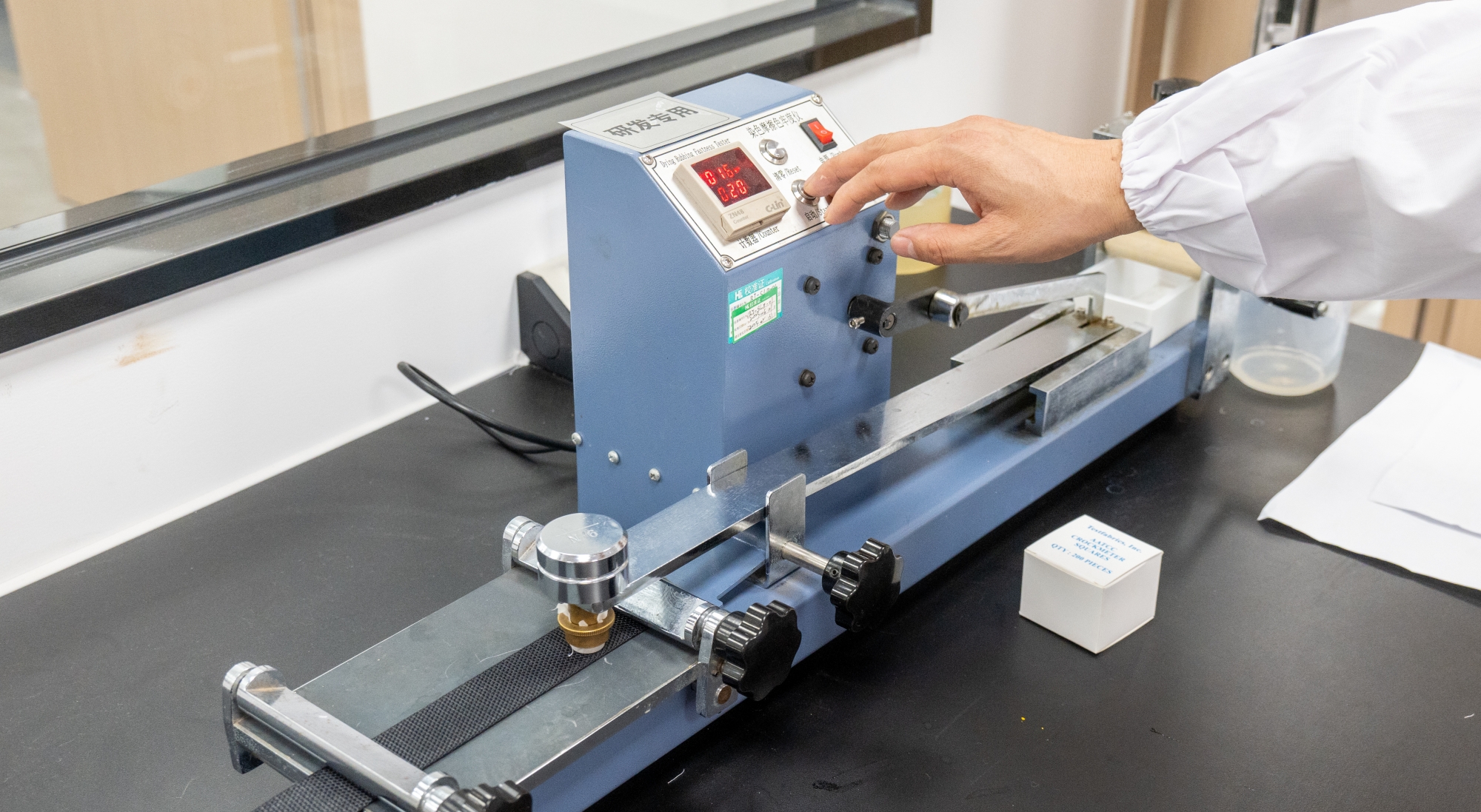
Light-exposure and colour fastness testing used to qualify outdoor webbing for camping applications.
Why Camping Webbing Fails: The Two Mechanisms That Matter
Camping gear is exposed continuously rather than occasionally. Webbing on a tent, a hammock or a pack spends seasons in direct sun, then gets soaked, then dries in the wind, then repeats the cycle. Failure almost always traces back to one of two mechanisms — and often to both at the same time.
UV degradation
Ultraviolet light breaks down polymer chains in nylon and polyester. The visible result is colour fade. The invisible result is a slow loss of tensile strength, which is why a strap can still look acceptable while no longer performing to its original specification. Colour fastness to light is the practical proxy the industry uses to measure this, and it is reported on a grey scale where Grade 4 means a slight change and Grade 4.5 sits between slight and no change.
- Camping webbing in the Jude Webbing range is tested to UV fastness Grade 4.5 after 1,000 hours (ISO 105).
- High-tenacity polyester webbing is tested to UV fastness Grade 4.5 after 500 hours (ISO 105).
- Bluesign webbing in the range is tested to UV resistance Grade 4 (BS EN ISO 105-B02).
Water absorption and wet-dry cycling
Water performance is usually reported two different ways, and the two are often confused in specification sheets.
- Water absorption is a percentage. Camping webbing and high-tenacity polyester webbing in this range are specified at less than 0.5% water absorption.
- Water repellency is a surface behaviour, normally expressed as a spray rating. RPET webbing, recycled webbing and other constructions in the range offer optional water repellency of Grade 4 under AATCC 22.
Specification tip: "Waterproof" and "water-repellent" are not interchangeable in a webbing specification. Ask for the absorption figure and the spray rating separately, because a strap can shed surface water quickly and still take on weight in prolonged rain.
Why the two mechanisms interact
Wet webbing under tension ages faster than dry webbing under the same load. Moisture in the weave, combined with UV exposure and mechanical cycling at buckle contact points, produces the durability problems camping brands most often see in returns: colour banding on tent pole straps, straps that stiffen after repeated rain, and pack compression straps that gradually lose grip and hand-feel.
Industry Background: Where Outdoor Webbing Demand Is Going
The commercial context explains why UV and water performance have moved from a nice-to-have to a line item in most camping gear specifications.
- The global webbing market was valued at USD 4.2 billion in 2023 and is projected to reach USD 5.7 billion by 2030, driven significantly by the outdoor recreation industry (Grand View Research).
- Asia Pacific held a revenue share of 66.3% of the webbing market in 2023, largely because of manufacturing infrastructure in countries including China and Vietnam (Grand View Research).
- Recycled polyester (rPET) accounted for approximately 15–18% of global polyester fibre production in 2024, reflecting the shift toward GRS-certified sustainable webbing (Textile Exchange data cited by industry sources).
- Polyester webbing remains the dominant material for leisure activities in the United States, used in approximately 60% of leisure products, while nylon webbing is the fastest-growing segment in sporting goods because of its strength-to-weight ratio and elasticity (IMARC Group).
Publicly tracked manufacturers in the wider webbing sector include National Webbing Products Co., American Cord & Webbing Co. (ACW) and Murdock Webbing Company, alongside Asia-Pacific specialists such as Jude Webbing (Xiamen Jude Webbing Co., Ltd.). Jude Webbing operates a 25,800 m² production base in Xiamen and Vietnam with full-chain weaving, printing, dyeing, finishing and assembly, and exports around 70% of output to markets including Germany, Switzerland, Sweden, Finland, Poland, the United Kingdom, France, Canada, and Southeast Asia.
The practical consequence for specifiers is straightforward. UV resistance, water repellency and certified material sourcing are now baseline requirements for camping webbing rather than differentiators, and buyers increasingly need documentation that travels with the shipment.
How UV and Water Resistance Are Actually Measured
Performance claims are only as strong as the test method behind them. Camping webbing specifications should name the standard and the exposure duration, not just the property.
- UV and light fastness: ISO 105, AATCC 16.3, and BS EN ISO 105-B02 are the methods most often quoted, reported as a grey scale grade plus an exposure duration in hours.
- Colour fastness to washing: ISO 105-C06, where GRS webbing in the range achieves Grade 4–5.
- Water absorption: reported as a percentage, with camping webbing and polyester webbing specified at below 0.5%.
- Water repellency: AATCC 22 spray rating, offered at optional Grade 4.
- Salt water resistance: ISO 105-E02, where nylon outdoor webbing achieves Grade 4–5.
Independent verification is the second half of the picture. Third-party test reports held for the Jude Webbing range include an SGS anti-UV test report to ISO 105, an SGS colour fastness test report to AATCC 186 and ISO 105, and an SGS breaking strength test report to PIA-Test Method-4108A-2005.
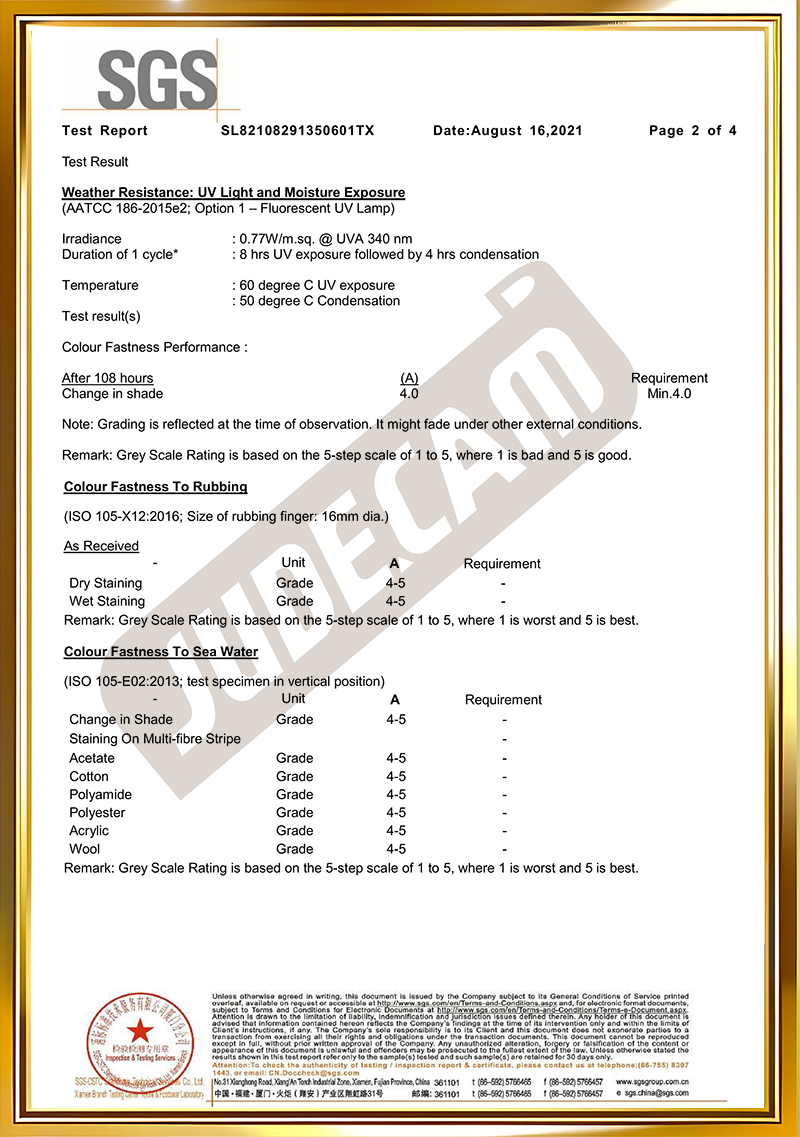
Third-party colour fastness test report (AATCC 186 / ISO 105) used to substantiate light fastness claims.
Choosing the Right Construction for Camping Gear
Different camping products place different demands on the same two properties. The constructions below are the ones most relevant to camping gear programmes, with the performance figures each one is specified against.
Camping webbing (UV-stabilised nylon / high-tenacity polyester)
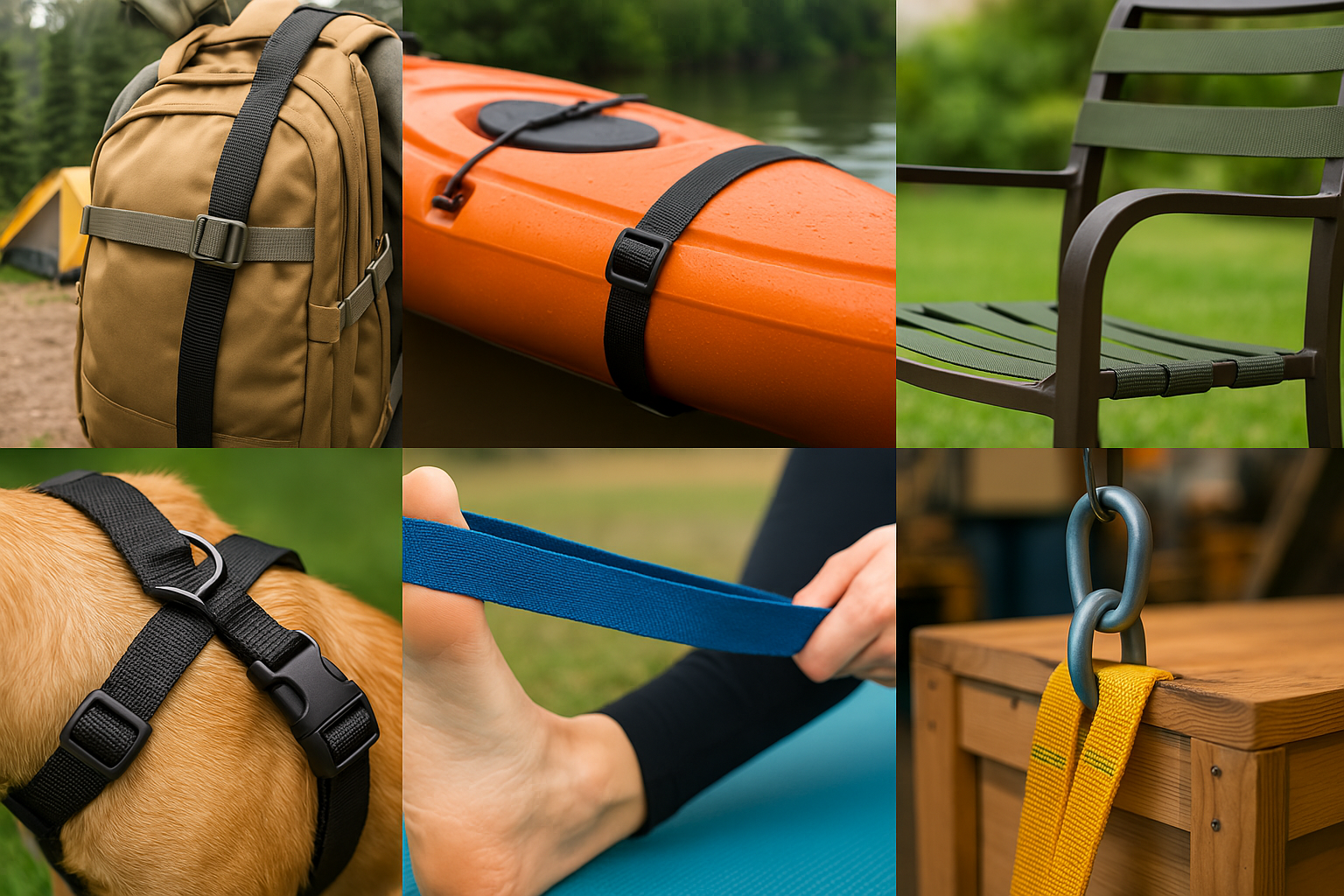
This is the general-purpose construction for adventure infrastructure. UV fastness reaches Grade 4.5 after 1,000 hours (ISO 105) and water absorption is below 0.5%. Stiffness is optimised for YKK and Duraflex buckle compatibility, and edges are friction-free ultrasonic cut. Documented applications include tents, hammocks, camping furniture and tree straps.
High-tenacity polyester webbing
Polyester is the workhorse for long-exposure, low-elongation duty. UV fastness is Grade 4.5 after 500 hours (ISO 105), water absorption is below 0.5%, acid resistance is excellent, and breaking strength runs from a minimum of 500 lbs to 2,000 lbs depending on specification. Documented applications include outdoor backpacks, marine equipment, long-term outdoor tie-downs and solar sail edges.
Nylon outdoor webbing
Where soft hand-feel and abrasion tolerance matter more than absolute UV hold, high-tenacity nylon with a soft-touch finish is the usual choice. Colour fastness to light is Grade 4 (ISO 105-B02) and salt water resistance is Grade 4–5 (ISO 105-E02). Documented applications include outdoor backpacks, mountaineering packs, technical rucksacks, camera bags, performance apparel belts and premium pet accessories.
RPET webbing
Made from 100% high-tenacity post-consumer recycled polyester yarn, RPET webbing delivers UV resistance Grade 4 after 500 hours (ISO 105), optional water repellency Grade 4 (AATCC 22), and shrinkage below 3% at 100°C. It is used in sustainable luggage and eco-friendly tent components.
Recycled webbing and GRS webbing
Recycled webbing carries UV resistance Grade 4–5 (AATCC 16.3) and optional water repellency Grade 4 (AATCC 22), with source verification covering pre- and post-consumer waste. GRS webbing adds 50%–100% recycled content verified by Transaction Certificate, colour fastness to washing Grade 4–5 (ISO 105-C06), and a full chain of custody. Both are used in mass-market sustainable outdoor gear.
Bluesign webbing
Bluesign System Partner nylon or polyester with UV resistance Grade 4 (BS EN ISO 105-B02), REACH and OEKO-TEX compliance, and zero restricted chemicals per the Bluesign RSL. It is aimed at Tier-1 outdoor apparel and sustainable technical packs.
Across these constructions, common specification ranges are width 20/25/38/50 mm and 1/2", 1", 1.5", 2" (customised), thickness 1.20 mm (customised), packaging of 50 meters per roll, and weave structures covering twill, plain, flat, herringbone and tubular. Custom Pantone colour matching is available on the polyester construction, and colour, pattern, width, thickness, softness, UV resistance and water-repellent finishing are all configurable.
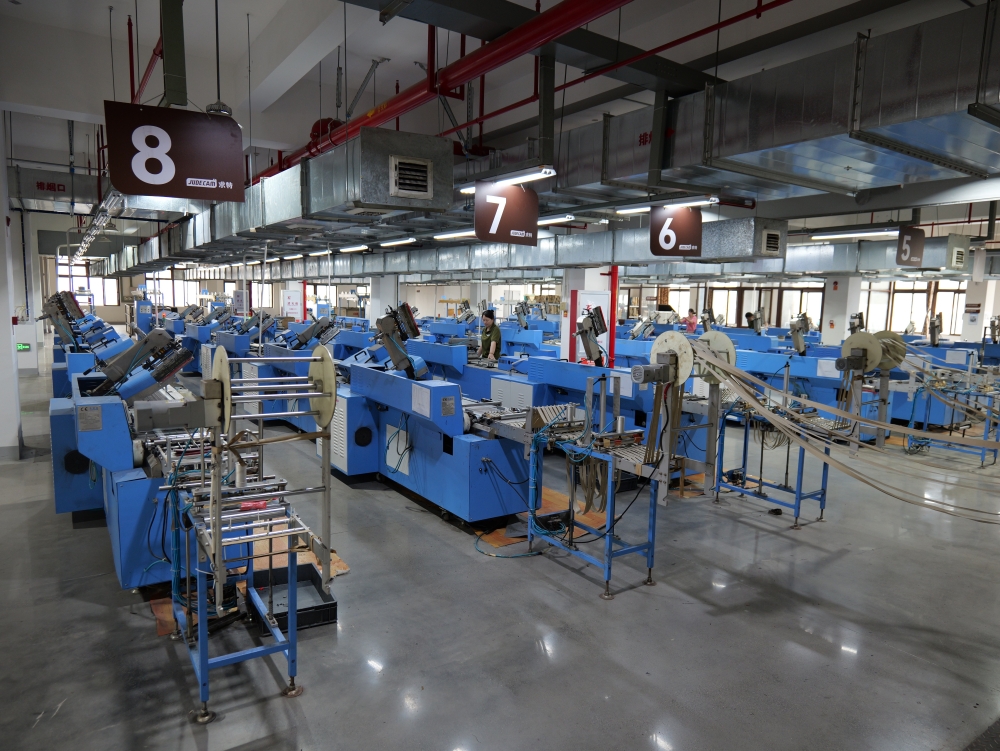
In-house printing capability supports custom colour and pattern development on camping and outdoor webbing.
Certifications That Support Your UV and Water Claims
Camping gear programmes are increasingly audited on material documentation, so the certification set matters as much as the performance grade. Jude Webbing holds the following for its webbing range:
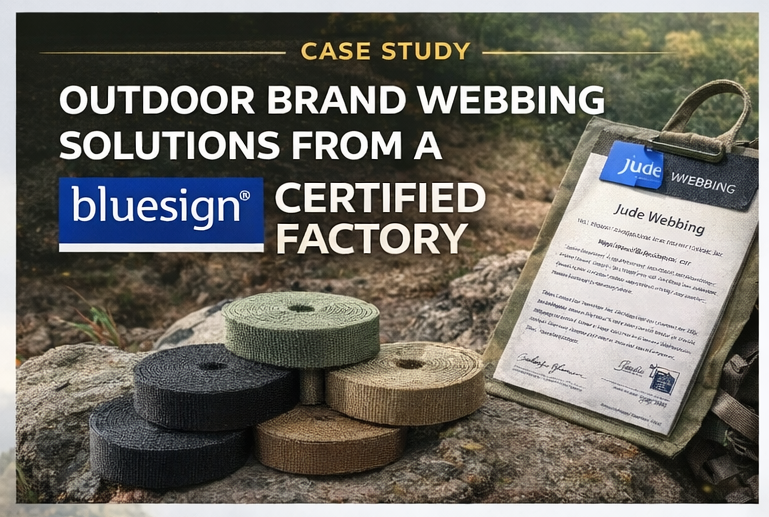
- Bluesign System Partner (scope: webbings/ribbons), with zero restricted substances per the Bluesign RSL.
- GRS 4.0 certification with Transaction Certificate support and full chain of custody.
- OEKO-TEX Standard 100 Class I (baby-safe articles).
- REACH and OEKO-TEX compliance, plus RSL testing (Nonylphenol/Octylphenol in Textiles, EN ISO 21084), an AZO & PCP free test report, and a ROHS test report.
- ISO 9001:2015 (quality), ISO 14001:2015 (environmental) and ISO 45001:2018 (occupational health and safety), covering the design and processing of functional webbing and webbing-finished products.
- SGS performance reports for anti-UV, colour fastness and breaking strength.
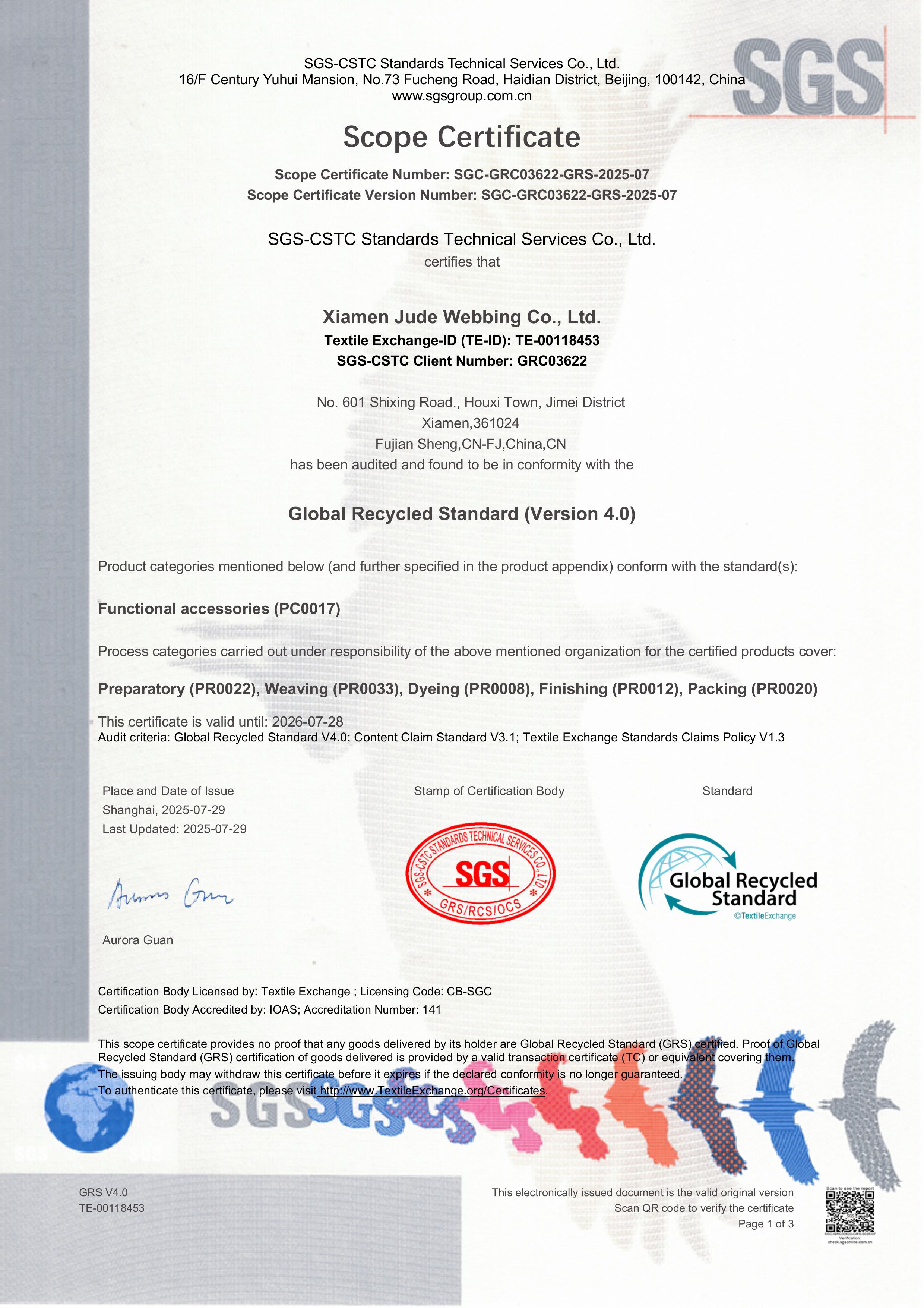
GRS 4.0 certification underpins recycled content claims on RPET and recycled webbing.
Step-by-Step: Specifying Camping Webbing
The sequence below is the order in which specification decisions affect cost, risk and lead time. Changing the UV target after the material is chosen is far more expensive than setting it first.
- Map the exposure profile. Estimate realistic sun hours and wet hours per season, plus peak load and whether the strap is under constant tension. A tent guy-out point and a cooler bag handle do not need the same durability target.
- Select the base material. Polyester for long-exposure, low-elongation duty; nylon for soft hand-feel and abrasion tolerance; RPET or recycled yarn where recycled content is a programme requirement.
- Set the UV target and name the method. For example, Grade 4.5 after 1,000 hours (ISO 105) for camping webbing, or Grade 4.5 after 500 hours for polyester.
- Set the water target separately. Specify an absorption limit (below 0.5% is achievable) and, if surface shedding matters, an AATCC 22 spray rating of Grade 4.
- Match the certification set to your market. Bluesign System Partner, GRS 4.0, OEKO-TEX Standard 100 Class I and REACH cover most European and North American retail requirements.
- Validate with a counter sample. Bulk production must match the approved pre-production sample in colour, hand-feel and texture.
- Lock the specification and verify before shipment. Pre-shipment functional verification of UV resistance grade and water repellency should be carried out according to ISO standards.
Manufacturing base producing UV-stabilised and water-repellent outdoor webbing for camping gear programmes.
Use Cases: Matching Webbing to the Camping Product
- Tents and guy-out points. Camping webbing at UV fastness Grade 4.5 after 1,000 hours (ISO 105) with water absorption below 0.5% addresses both the sun and the rain side of a tent's life cycle.
- Hammocks and tree straps. High-tenacity polyester and UV-stabilised constructions combine load-bearing capacity with low water absorption, which keeps weight and drying time predictable.
- Camping furniture. Tubular webbing is specified at 15 kN–25 kN breaking strength with a seamless circular hollow weave, and is documented for camping furniture and tree straps alongside climbing slings.
- Modular packs and carrying systems. One outdoor gear brand client uses backpack webbing at more than 300,000 meters per year across multiple European countries, the US and Asia, for modular backpacks, expandable carrying systems and outdoor gear accessories. Reported highlights are modular attachment compatibility, a lightweight and flexible design, high durability under repeated use, and custom colour and pattern options, with performance maintained for 2–3 years under regular outdoor usage.
- Cooler bags, travel gear and luggage. A global outdoor brand client uses recycled webbing and RPET webbing at more than 1,000,000 meters annually for outdoor backpacks, cooler bags and travel gear, with clients across Germany, Switzerland, Sweden, the United Kingdom, Finland, Poland, Estonia, the Netherlands, Vietnam, Malaysia and Norway. The project improved the product sustainability profile while maintaining durability and colour consistency, with performance continuing after 2–4 years of outdoor usage.
- Pet accessories. Premium pet accessories and professional pet leashes are documented applications for nylon outdoor webbing and tubular webbing, where soft-touch hand-feel and salt water resistance matter.
Comparison Table: Camping Webbing Options by UV and Water Performance
| Construction | Base material | UV performance | Water performance | Certification baseline |
|---|---|---|---|---|
| Camping Webbing | UV-stabilised nylon / high-tenacity polyester | UV fastness Grade 4.5 after 1,000 h (ISO 105) | Water absorption <0.5% | Bluesign System Partner, GRS 4.0, OEKO-TEX Standard 100 Class I |
| Polyester Webbing | 100% high-tenacity polyester filament | UV fastness Grade 4.5 after 500 h (ISO 105) | Water absorption <0.5% | Bluesign System Partner, GRS 4.0, OEKO-TEX Standard 100 Class I |
| Nylon Outdoor Webbing | High-tenacity nylon (soft-touch finish) | Colour fastness to light Grade 4 (ISO 105-B02) | Salt water resistance Grade 4–5 (ISO 105-E02) | Bluesign System Partner, GRS 4.0, OEKO-TEX Standard 100 Class I |
| RPET Webbing | 100% post-consumer recycled polyester yarn | UV resistance Grade 4 after 500 h (ISO 105) | Optional water repellency Grade 4 (AATCC 22); shrinkage <3% at 100°C | Bluesign System Partner, GRS 4.0, OEKO-TEX Standard 100 Class I |
| Recycled Webbing | 100% post-consumer recycled polyester yarn | UV resistance Grade 4–5 (AATCC 16.3) | Optional water repellency Grade 4 (AATCC 22) | Bluesign System Partner, GRS 4.0, OEKO-TEX Standard 100 Class I |
| Bluesign Webbing | Bluesign System Partner nylon / polyester | UV resistance Grade 4 (BS EN ISO 105-B02) | Not separately specified in the range data; REACH and OEKO-TEX compliant | Bluesign System Partner, GRS 4.0, OEKO-TEX Standard 100 Class I, REACH |
Two clarifications keep this table usable in a real specification. First, UV grades are only comparable when the exposure duration and the test method match, so a Grade 4 after 500 hours and a Grade 4 after 1,000 hours are not the same claim. Second, water performance is split between absorption and surface repellency; where a construction lists an optional repellent finish, the finish has to be ordered explicitly rather than assumed.
Frequently Asked Questions
Which certifications should sit behind a UV or water-repellency claim on camping webbing?
Two layers are needed. The first is material compliance: Bluesign System Partner, GRS 4.0, OEKO-TEX Standard 100 Class I (baby-safe), REACH and OEKO-TEX compliance, plus RSL, AZO & PCP free and ROHS test reports. The second is performance evidence: an anti-UV test report to ISO 105, a colour fastness test report to AATCC 186 and ISO 105, and a breaking strength test report. Jude Webbing holds these reports from SGS, and its management systems are certified to ISO 9001:2015, ISO 14001:2015 and ISO 45001:2018.
Can UV resistance and water repellency be specified together on the same webbing order?
Yes. The manufacturer's ODM scope explicitly covers material selection, colour matching and pattern customisation, and customisation includes colour, pattern, width, thickness, softness, UV resistance and water-repellent finishing. In practice, RPET webbing can be specified at UV resistance Grade 4 after 500 hours (ISO 105) with optional water repellency Grade 4 (AATCC 22), while camping webbing reaches UV fastness Grade 4.5 after 1,000 hours (ISO 105) with water absorption below 0.5%. Widths run from 20 mm to 50 mm and 1/2" to 2", with thickness customisable from the 1.20 mm baseline.
What MOQ applies to customised camping webbing, and what commercial terms are typical?
MOQ is 3,000 meters per colour per specification for webbing, and 5,000 meters per colour per specification for binding tape. Small-batch trial orders are supported for startup outdoor brands, and free samples are available for existing stock items. Delivery can be arranged on flexible Incoterms including FOB, CIF, DAP and DDP by sea, air or express, and payment terms are typically T/T with 30% deposit and 70% before shipment, or confirmed L/C at sight, with flexible terms for long-term strategic partners. Monthly capacity is approximately 25,000,000 yards.
How is a camping webbing sample validated before bulk production?
Validation runs on counter-sample matching: bulk production must match the approved pre-production sample in colour, hand-feel and texture. Free samples are available for existing stock items, and trial orders can be placed on flexible MOQ terms so that a new construction can be tested on the actual buckle, sewing line and finishing process before commitment. After approval, pre-shipment functional verification of UV resistance grade and water repellency is carried out according to ISO standards.
What lead time should brands plan for, and how do I start an evaluation?
Lead time is 7–25 days depending on order size and the amount of customisation, supported by a production base of 25,800 m² across Xiamen and Vietnam and a monthly capacity of approximately 25,000,000 yards. For programmes that need a starting point, the manufacturer provides OEM and ODM services covering design customisation, branding support, material selection, colour matching and pattern customisation, plus value-added services such as precision cutting, punching, sewing and finished product assembly. To begin, send your exposure profile, target UV grade and required width to Jude Webbing at judewebbing.com and request a sample for evaluation.
Ready to Specify Camping Webbing for Your Next Programme?
Share your UV target, water-repellency requirement, colour and width, and request a sample for evaluation. Technical consultation is available for OEM and ODM projects, including material selection, colour matching and pattern development.
Email: judecam@judegroup.com | Tel: 86-592-6361058 | WhatsApp: +86 13358399583
Website: www.judewebbing.com
Request a sample, quote or catalogue for UV-resistant and water-repellent camping webbing.
Conclusion
UV resistance and water repellency are the two webbing properties that most directly determine how a camping product performs after a full season outdoors. The specification discipline is to name the test method and the exposure duration for UV, to separate water absorption from surface repellency, and to confirm that the certification set matches the destination market. With UV fastness up to Grade 4.5 after 1,000 hours (ISO 105), water absorption below 0.5%, optional water repellency Grade 4 (AATCC 22), and a certification portfolio covering Bluesign System Partner, GRS 4.0, OEKO-TEX Standard 100 Class I, REACH and ISO 9001/14001/45001, camping webbing can be specified against measurable performance rather than descriptive claims.
Have Questions or Need More Details?
Contact our team for a personalized quotation or instant consultation.
Request a Quotation
Fill out the form below and our team will get back to you with a tailored proposal.
WhatsApp Direct Chat
Prefer to chat in real-time? Message us on WhatsApp for instant assistance & quick answers.
- Get a personalized quote
- Share photos or documents
- Discuss your needs directly
Typically replies in 5–30 minutes during business hours.