MicroGuard vs AgingGuard: Outdoor Webbing by Failure Mode
Weather, moisture and time attack outdoor webbing in more than one way. A shoulder strap that spends its life against a sweaty back is a different engineering problem from a tie-down that spends its life in direct sun, even when both are cut from the same width and the same colour. MicroGuard and AgingGuard are two functional webbing lines from Jude Webbing (JUDECAM) that were developed against two different failure modes: microbial growth and odour in warm, humid, high-contact use, and strength loss from sunlight, rain, moisture and repeated temperature change.
Choosing between them is not a ranking exercise. It comes down to which mechanism is most likely to end your product's service life first, and whether the evidence you hold actually covers that mechanism. This guide sets out the documented test data for each line, explains what those tests do and do not establish, and closes with a buyer checklist you can apply at the sample stage.
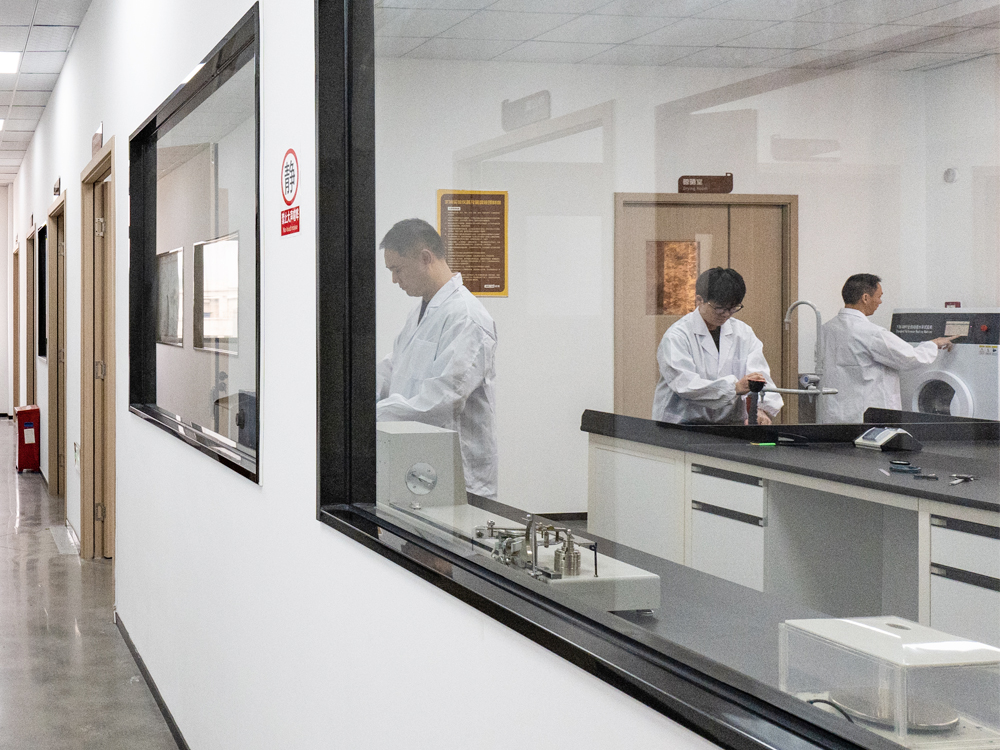
Jude Webbing's in-house webbing testing laboratory. Third-party evidence, such as the SGS anti-mould challenge and the 400-hour UV/condensation run, is generated by external laboratories.
The decision problem: two failures, two test regimes
Microbial failure and weathering failure produce similar complaint notes and completely different laboratory results. Webbing's job in a finished product is load support, safety restraint and shock distribution, and both failure modes undermine that job — but they get there by separate routes and must be specified separately.
Microbial failure — mould, mildew and odour — is a moisture, warmth and nutrient problem. Webbing holds moisture in its weave, in coated edges and in stitched seams, and a pack that is packed wet and closed for a day is an incubation chamber. Anti-mould protocols therefore fix temperature and relative humidity for a defined period and assess how the sample behaves under that sustained challenge.
Weathering failure is an energy problem. Ultraviolet radiation breaks polymer chains; condensation, rain and repeated temperature change add hydrolysis and mechanical stress. The visible symptom is often fading, but the functional loss is breaking strength. UV/condensation protocols therefore alternate light exposure with moisture at elevated temperature and measure strength before and after.
The two protocols do not overlap. An anti-mould chamber applies no UV load, and a UV/condensation chamber is not scored for fungal growth. A result from one test cannot be read across to the other. That is the most common specification error in functional webbing sourcing: a buyer sees one strong test number and assumes it covers the whole outdoor envelope.
Why functional webbing became a specification line
Webbing used to be bought as a width and a colour. It is now increasingly bought as a performance claim with documentation attached, for two reasons.
First, gear is sold into more climate zones than it is designed for. A pack range built for a European summer is regularly worn and stored in Southeast Asia, and marine equipment specified in one market is stored wet in another. Second, compliance paperwork now travels with the order. Jude Webbing's product parameters list Bluesign System Partner status, GRS 4.0 and OEKO-TEX Standard 100 Class I for its recycled and eco-friendly webbing, and buyers who apply that documentation discipline to sustainability claims are applying the same discipline to performance claims.
The category is also large enough that specification habits repeat. Grand View Research valued the global webbing market at USD 4.86 billion in 2026, with Asia Pacific holding 66.3% of revenue in 2023 (Grand View Research, 2026). When a material choice is locked in once, it tends to be repeated across seasons and SKUs — which is why the failure-mode question is worth settling before the first bulk order rather than after the first return season.
Both lines examined here come out of the same manufacturing environment. Jude Webbing reports a 25,800 m² production base across Xiamen and Vietnam with in-house weaving, dyeing, finishing and assembly, and a 70% export share. That matters to the comparison only in one respect: the two lines are made on the same equipment, so the choice between them is a specification decision, not a supplier decision.
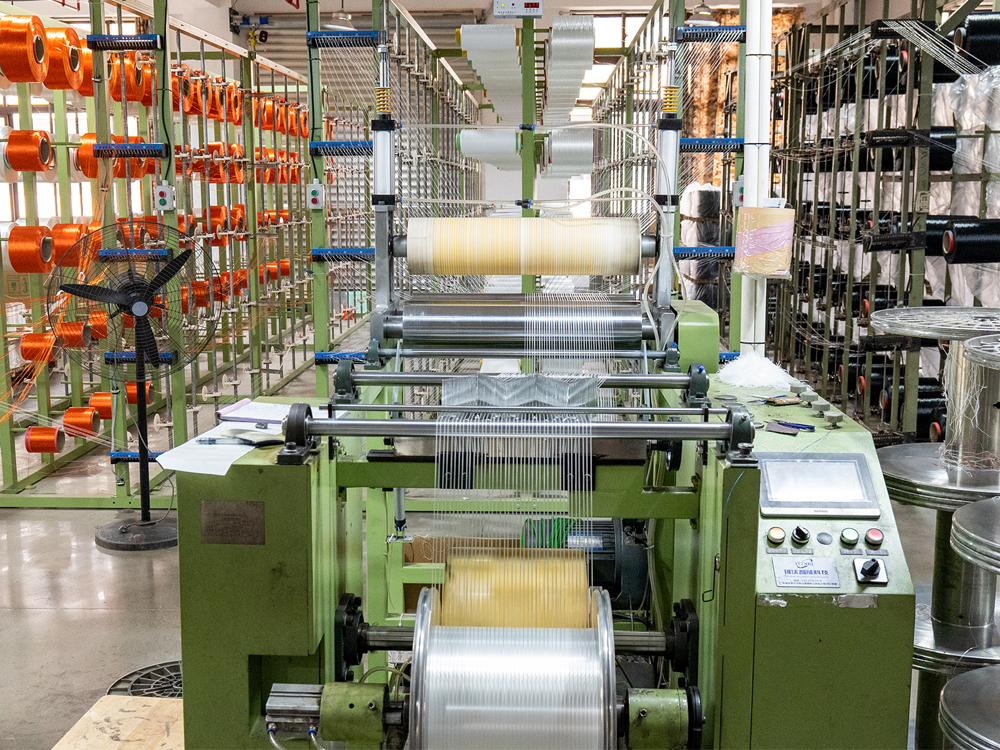
Yarn warping: the base polymer is set before weaving, which is why the choice between a nylon 66 build and an aging-resistant build is made upstream of the loom.
MicroGuard: anti-mould webbing for humid, high-contact gear
MicroGuard is an antimicrobial, anti-mould webbing built on a nylon 66 (polyamide 6.6) base and offered in widths from 20 mm to 50 mm. Its documented performance evidence is an SGS anti-mould test to GB/T 24346-2009, run for 28 days at 28 °C and 90% relative humidity.
Those conditions are the point. Twenty-eight days at 28 °C and 90% RH is a sustained humid challenge, not a short dip: it holds the sample inside the temperature and moisture band where mould actually establishes, and it holds it there long enough for a slow-growing organism to show up. For a buyer, the practical reading is that the test answers a storage-and-use question — gear that stays damp inside a bag, a locker, a boat cabin or a shipping container — rather than a sunlight question.
The nylon 66 base matters for a second reason. Polyamide 6.6 is a load-bearing polymer in this range, not a trim material: Jude Webbing's tubular webbing, also built on 100% high-strength polyamide 6.6, is rated at 15 kN to 25 kN and has passed UIAA certification through a European testing agency. That is a separate product with its own certificate and it is not evidence about MicroGuard; it simply shows the polymer family the line is built on. MicroGuard's own documented evidence is the anti-mould test.
The 20–50 mm width range covers most of what a gear programme needs from a functional strap, from narrow adjustment and lash points at the low end to wider belt and tie-down work at the high end. Width, thickness and colour should still be confirmed on the sample, because strength and hand feel change with width even when the polymer does not.
Where MicroGuard stops
The anti-mould protocol says nothing about UV exposure, and it is not a strength-retention test. If your gear is rigged outdoors in direct sun for months, this test does not cover the mechanism that will age it. It also does not make a wet pack dry: the treatment addresses growth on and in the webbing, not the moisture management of the product around it.
AgingGuard: aging-resistant webbing for long sun and wet–dry cycling
AgingGuard is an aging-resistant webbing documented with a 400-hour fluorescent UV/condensation test. Breaking strength measured 29,913 N before aging and 28,760 N after, a loss of 3.9%.
The test design is the mirror image of the anti-mould protocol. Fluorescent UV lamps deliver a controlled UV dose, and condensation cycles add moisture at elevated temperature. That combination matters because outdoor aging is rarely pure photodegradation: sunlight breaks chains, moisture and heat drive hydrolysis, and repeated wet–dry and hot–cold cycles add mechanical stress. A UV-only test would miss part of that.
The strength pair is more useful than either number on its own. At 29,913 N initial and 28,760 N after aging, the tested build retained about 96% of its tested breaking strength across the 400-hour exposure; the 3.9% figure is the calculated difference between the two measurements (29,913 − 28,760 = 1,153 N). Quoting only the initial strength tells you what the webbing does when new. Quoting the pair tells you what it does after weathering, which is the number that governs a safety margin.
Three qualifications belong next to those figures. First, breaking strength in newtons is a property of a specific build: it scales with width, construction and thickness, so 29,913 N belongs to the tested sample and not automatically to every AgingGuard width. Second, 400 hours is a defined test duration, not a service life; it reports retained strength at that exposure, not what happens at 800 hours or after several seasons on a rooftop. Third, a UV/condensation chamber is not a microbiological test — it produces no data on mould, mildew or odour.
Where AgingGuard stops
It is the wrong specification for the failure that starts inside a damp bag. If your return reason is smell rather than a snapped strap, this test is not answering your question, and no amount of UV data will substitute for an anti-mould result.
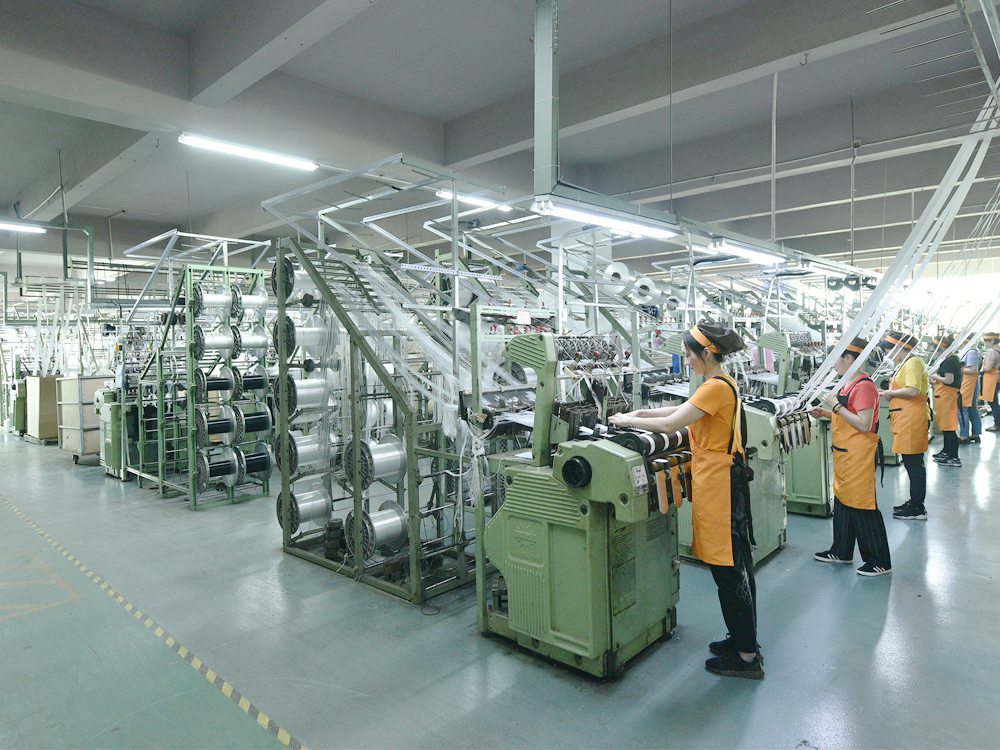
Webbing weaving. Construction and width change breaking strength, which is why a strength figure must stay attached to the build that produced it.
MicroGuard vs AgingGuard: documented comparison
The table compares the two lines only on what is documented. It is a decision aid, not a ranking: neither line is the better product in general, and neither test substitutes for the other.
| Dimension | MicroGuard | AgingGuard |
|---|---|---|
| Failure mode targeted | Microbial growth, mildew and odour in warm, humid, high-contact use | Strength loss from UV, rain, moisture and repeated temperature change |
| Documented test | SGS anti-mould test to GB/T 24346-2009 | Fluorescent UV/condensation exposure, 400 hours |
| Test conditions | 28 days at 28 °C and 90% relative humidity | 400 hours of alternating UV exposure and condensation cycling |
| Measured outcome | Anti-mould performance assessed under the stated sustained humid challenge | 29,913 N initial breaking strength; 28,760 N after aging |
| Strength retention | Not the parameter this protocol reports | 3.9% loss (calculated from the two supplied measurements) |
| Base and widths | Nylon 66 base; 20–50 mm widths | Confirm base polymer and width against your own build at sample stage |
| Strongest fit | Gear worn or stored against the body in humid climates | Gear left exposed to sun and wet–dry cycles for long periods |
| Weaker fit | Long-term direct-sun exposure is outside what the test covers | Mould and odour control are outside what the test covers |
| Ask before ordering | The SGS report, plus the tested width, thickness and colour | The test report, the tested width, and the UV target your market requires |
How to choose: a five-step decision sequence
- Write the failure down in one sentence. Before comparing data sheets, complete this line: "This webbing will be replaced in the field because ______." If the answer is mould, odour or staining after humid storage, you are specifying against microbial failure. If it is fading, chalking or a strap that weakened after two seasons outdoors, you are specifying against weathering. That sentence determines which report is relevant.
- Convert exposure into a test specification. Estimate the hours of direct sun the part will see in a season, how long it stays wet after rain or immersion, and whether it sits against skin, sweat or sunscreen. MicroGuard's 28-day, 28 °C, 90% RH challenge is a humid-storage proxy; AgingGuard's 400-hour UV/condensation run is an outdoor-exposure proxy. If your real conditions exceed either envelope, say so and ask what data exists beyond it.
- Check the report, not the claim. For each line, confirm the method number (GB/T 24346-2009 for MicroGuard's anti-mould test), the laboratory (SGS for that test), the duration and conditions, and the exact build tested — width, thickness and colour. A result without the build attached cannot be transferred to your SKU.
- Split the bill of materials by zone. A single pack can need both lines. The sun-exposed lash panel and the body-contact shoulder straps do not see the same environment, and specifying one webbing for both means over-specifying one zone and under-specifying the other.
- Approve on the sample, not the datasheet. Confirm width and thickness against the drawing, check colour against the Pantone target across two batches, and re-test if your conditions differ from the standard protocol. Jude Webbing states that it controls colour with colorimeters to Delta E < 1.0 and uses UV-stabilized additives for outdoor longevity — those are production controls worth verifying on the physical sample, because batch-to-batch colour consistency is a separate risk from either failure mode.
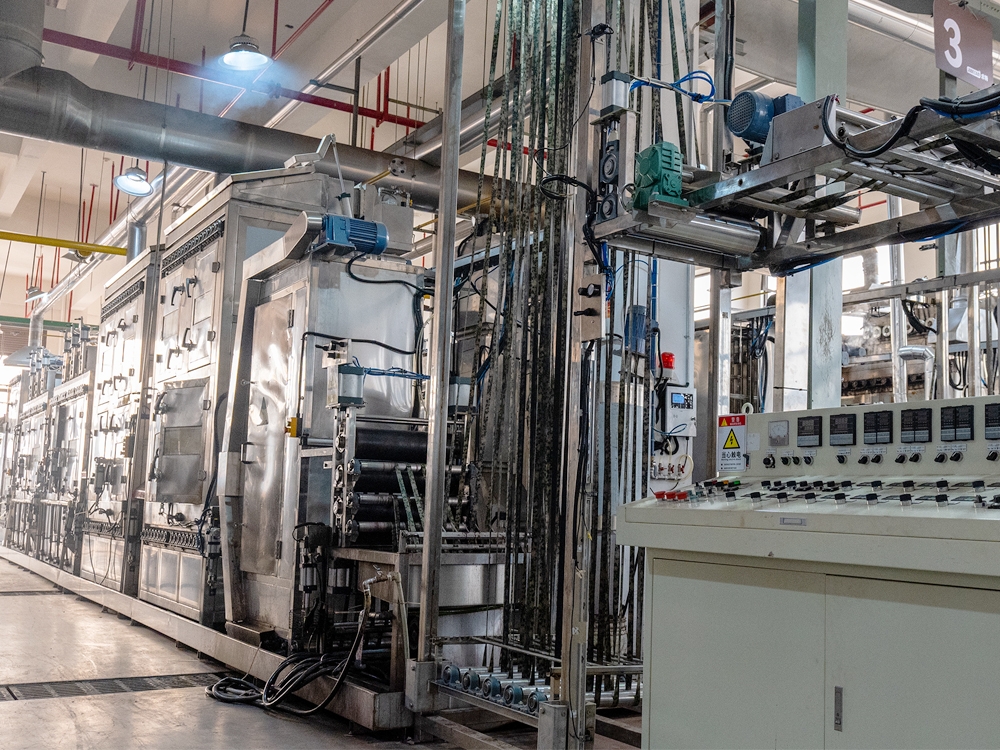
Colour processing and dyeing lines. Colour consistency is specified separately from anti-mould or anti-aging performance.
Use-case fit: which gear profile belongs to which webbing
Humid, high-contact applications — MicroGuard
Specify against microbial failure where the webbing spends its life warm, damp and in contact with the body or with stored moisture: packs worn daily in tropical and monsoon markets, hip belts and shoulder straps, climbing harness contact points, marine gear that lives aboard, pet harnesses and leashes, stroller and kids' gear, base-layer accessories, and any product that is routinely packed wet and reopened days later. Jude Webbing lists high-end outdoor backpacks, camping gear, climbing harnesses, marine equipment, pet accessories and performance sportswear among the applications for its functional outdoor webbing, and describes a daily-wear, repeated-adjustment mode of use — the humid, high-contact subset is where the anti-mould evidence earns its place.
Long sun and wet–dry cycling — AgingGuard
Specify against weathering where the webbing is rigged outdoors and stays there: long-term outdoor tie-downs, solar sail edges, marine topside fittings, tent and shelter components, and straps exposed to direct sun for a full season with no storage between uses. Jude Webbing's outdoor webbing range lists long-term outdoor tie-downs, marine equipment and solar sail edges among its applications, alongside sustainable luggage and eco-friendly tent components. These are the profiles where retained breaking strength, not odour control, is the governing number.
When the answer is both
Many programmes need a split. A technical pack might use the aging-resistant line on externally rigged compression and lash straps while using MicroGuard on the body-contact harness. A marine cover might use aging-resistant webbing on the sun-facing edge and anti-mould webbing on the parts that stay damp under the cover. The decision is per zone, not per product — and the specification document should say so, with the matching test report attached to each zone.
What neither test tells you
- Neither is a field trial. Both are defined laboratory protocols; your market's UV dose, humidity and use pattern may exceed the test envelope.
- Neither is finished-product certification. A webbing report supports the material choice; the gear's own standard, and any climbing, PPE or child-product obligations, still apply.
- Fading and strength loss are different outcomes. Colour change is controlled separately — by colour measurement and UV-stabilized additives — and should be specified separately from breaking-strength retention.
- Retention is not a warranty. A 3.9% loss at 400 hours describes a tested point under defined conditions, not a promise about years of service.
FAQ: MicroGuard vs AgingGuard
What standard is the MicroGuard anti-mould test run to?
MicroGuard is tested by SGS for anti-mould performance to GB/T 24346-2009, with a 28-day challenge at 28 °C and 90% relative humidity. Those four details — laboratory, method, duration and conditions — are what make the result comparable with another supplier's data. Ask for the report itself so you can see the tested build (width, thickness, colour) and the grading, not just a summary line on a datasheet.
Does AgingGuard's UV test also prove mould resistance?
No. The AgingGuard evidence is a 400-hour fluorescent UV/condensation test, which records how breaking strength changes after combined UV and moisture exposure — 29,913 N before aging against 28,760 N after, a 3.9% loss. A UV/condensation chamber is not scored for fungal growth, so it produces no anti-mould data. If a product needs both claims, it needs both tests.
Which line should a humid-climate backpack programme specify?
For the body-contact and storage zones, MicroGuard's anti-mould evidence addresses the failure that humid-climate returns usually describe: mould, mildew and odour after the pack is packed wet. For sun-exposed external straps on the same pack, the weathering data is the relevant evidence instead. Splitting the bill of materials by zone is usually more accurate than choosing one line for the whole product.
Is MicroGuard or AgingGuard the more expensive option?
No published price difference is available for the two lines, and the comparison would not be meaningful without the same width, thickness, colour and order quantity. Cost in functional webbing is driven by the base polymer, the additive package, width and construction, the colour programme, and the test documentation that ships with the order. Ask for both lines quoted on an identical specification so the only variable is the functional treatment.
What should I check on a sample before approving either line?
Check four things: width and thickness against the drawing, colour against the Pantone target across two batches, the test report against the build you are approving, and hand feel or stiffness at the width you actually need. If your service conditions are harsher than the standard protocol — longer sun exposure, longer wet dwell — raise that before approval and ask what additional data can be generated, rather than assuming the standard test covers it.
What lead time should I plan for, and how do I confirm it?
Production timing depends on width, colour, order quantity and the documentation you require, so it should be confirmed in writing on the quotation rather than inferred from the webbing type. The practical sequence is to send the exposure profile (humid storage, long sun, or both), the target widths, the colour reference and the test reports you need, then request a sample in your colour together with a quotation that states the production schedule. Jude Webbing handles those requests through its website, and a sample in hand is the fastest way to settle a MicroGuard-versus-AgingGuard question for a specific programme.
Conclusion
MicroGuard and AgingGuard answer two different questions, and the mistake is to treat them as two grades of the same answer.
If the returns you are trying to prevent involve mould, mildew, odour or staining after humid storage and heavy body contact, MicroGuard's SGS anti-mould test to GB/T 24346-2009 — 28 days at 28 °C and 90% RH on a nylon 66 base in 20–50 mm widths — is the evidence that speaks to that failure.
If the returns involve faded, chalked or weakened webbing after months of sun, rain and temperature cycling, AgingGuard's 400-hour fluorescent UV/condensation data — 29,913 N before aging, 28,760 N after, a 3.9% loss — is the evidence that speaks to that one.
Where a product spans both environments, split the bill of materials and attach the matching report to each zone. And in every case, approve on the sample: the test report tells you what the tested build did under defined conditions, and the sample tells you whether that build is the one you are ordering.

Jude Webbing's production base in Xiamen, where both webbing lines are woven, dyed and finished.
Have Questions or Need More Details?
Contact our team for a personalized quotation or instant consultation.
Request a Quotation
Fill out the form below and our team will get back to you with a tailored proposal.
WhatsApp Direct Chat
Prefer to chat in real-time? Message us on WhatsApp for instant assistance & quick answers.
- Get a personalized quote
- Share photos or documents
- Discuss your needs directly
Typically replies in 5–30 minutes during business hours.