What Is Stroller Webbing? Safety and Comfort in Baby Gear
Stroller webbing is the narrow woven strap that carries a harness, a recline adjuster or an attachment loop on a stroller, car seat, infant carrier or high chair. It is a component category with its own rule set, because the same strap is loaded repeatedly by an adult and touched continuously by a child.
That dual role is what makes stroller webbing different from general outdoor webbing. A strap built purely for tensile strength can be too stiff where it crosses a child's shoulder. A strap finished purely for softness can creep or fray at the buckle. Stroller webbing has to satisfy both requirements in one construction, and then prove it with documents rather than adjectives.
This guide explains what separates stroller webbing from other narrow woven webbing, which characteristics actually decide safety and comfort, and how a small brand can move from a trial length to volume production — including how a 3,000-meter minimum order quantity works for a startup developing its first stroller model.
Quick answer
- Definition: safety-certified narrow woven webbing used in strollers, car seats, infant carriers and high chairs.
- Two jobs at once: load-bearing performance under repeated buckle cycling, plus soft, smooth-edged contact with infant skin.
- Reference construction: 100% high-tenacity polyester or nylon filament, 20/25/38/50 mm (1/2", 1", 1.5", 2") widths, 1.20 mm thickness, rounded edges, fatigue test above 10,000 buckle cycles.
- Compliance baseline: OEKO-TEX Standard 100 Class I (Baby Safe), Bluesign System Partner, GRS 4.0 for recycled constructions.
The Problem: Why Standard Webbing Is the Wrong Starting Point
The most common mistake in juvenile product development is treating webbing as a commodity trim and cutting a general outdoor webbing to length. The failure modes that follow are predictable, and most of them surface after tooling is approved, not before.
- Edge hardness. A cut or woven edge that feels acceptable on a backpack can abrade a child's shoulder or neck over a long stroller ride. Stroller webbing is specified with rounded edges, a soft edge and a smooth surface for exactly this reason.
- Colour movement. Dark dyes on light-coloured harness pads, or shade drift between production lots, show up as visible complaints. Colour has to be controlled as a specification, not as a preference.
- Chemistry. Skin contact with a baby is a different compliance question from skin contact with an adult hiker. Restricted substances, azo dyes, chlorinated phenols and heavy metals move from a footnote to an approval gate.
- Buckle fit. Width and thickness tolerances that are fine for a lashing strap can cause a harness adjuster to jam or slip. The webbing has to be matched to the hardware, not to a catalogue page.
- Fatigue. A stroller harness is adjusted thousands of times in a product's life. Static strength testing alone does not describe that behaviour.
- Order size. For a startup, the real blocker is often commercial: development quantities are small, while industrial webbing is normally sold by the tonne or by high minimums.
Each of these is solvable, but only if the webbing is sourced as an engineered juvenile component with a documented specification and a validation step.
Industry Background: Why Stroller Webbing Became Its Own Category
Webbing is a large, mature textile segment, and juvenile products sit inside a wider outdoor and functional webbing supply chain. A 2026 commercial market estimate places the global webbing market at USD 4.86 billion, with Asia Pacific holding a 66.3% revenue share in 2023 — which is why most stroller webbing programmes are developed with Asian webbing mills and finished by the stroller brand's own assembly partners.
The compliance side of the category has tightened at the same time. Two forces are visible in the documents buyers now request:
- Baby-contact standards. OEKO-TEX Standard 100 Class I is written specifically for baby articles, which means the certificate must cover the actual article class and the actual fibre composition — not a neighbouring product.
- Recycled content and chemistry. GRS 4.0 chain-of-custody documentation and Bluesign System Partner approval have moved from a differentiator to a standard line item in supplier questionnaires. Bluesign reports that its system partners achieved a 17% intensity reduction in CO2 emissions in 2024, which is one reason certification now appears in procurement criteria rather than only in marketing.
The practical result is that stroller webbing is bought as a documented component: fibre and construction, dimensions, edge treatment, cyclic durability, chemistry and certificate scope are all part of the purchase specification.
What Stroller Webbing Is — and What It Must Do
Base material: high-tenacity filament yarns
Stroller webbing from Xiamen Jude Webbing Co., Ltd. (JUDECAM) is made from 100% high-tenacity polyester or nylon filament. High-tenacity filament is chosen because it delivers strength at a lower mass than standard yarn, which keeps the strap thin enough to run through a harness adjuster while still carrying the load case.
Polyester and nylon are both offered for this product; the choice between them, and the finish applied to either, is decided per project rather than prescribed for the category.
Width and thickness: match the buckle, not the catalogue
Standard stroller webbing widths are 20 mm, 25 mm, 38 mm and 50 mm, equivalent to 1/2", 1", 1.5" and 2", with customization available. Standard thickness is 1.20 mm, also customizable. Both dimensions are set by the hardware: the webbing must thread a buckle, a slide adjuster or a ladder lock without jamming, and must not slip under load once adjusted. Packaging is 50 meters per roll, which suits line-side handling in a stroller assembly cell.
Softness: an engineering requirement, not a cosmetic finish
Comfort in a stroller harness is decided at the edges and the surface. Stroller webbing is produced with rounded edges for infant skin protection, plus a soft edge and a smooth surface described as child-safe. This is a construction and finishing decision rather than a coating: it survives washing, folding and repeated adjustment because it is part of how the tape is woven and finished.

Skin safety: the certification stack behind the strap
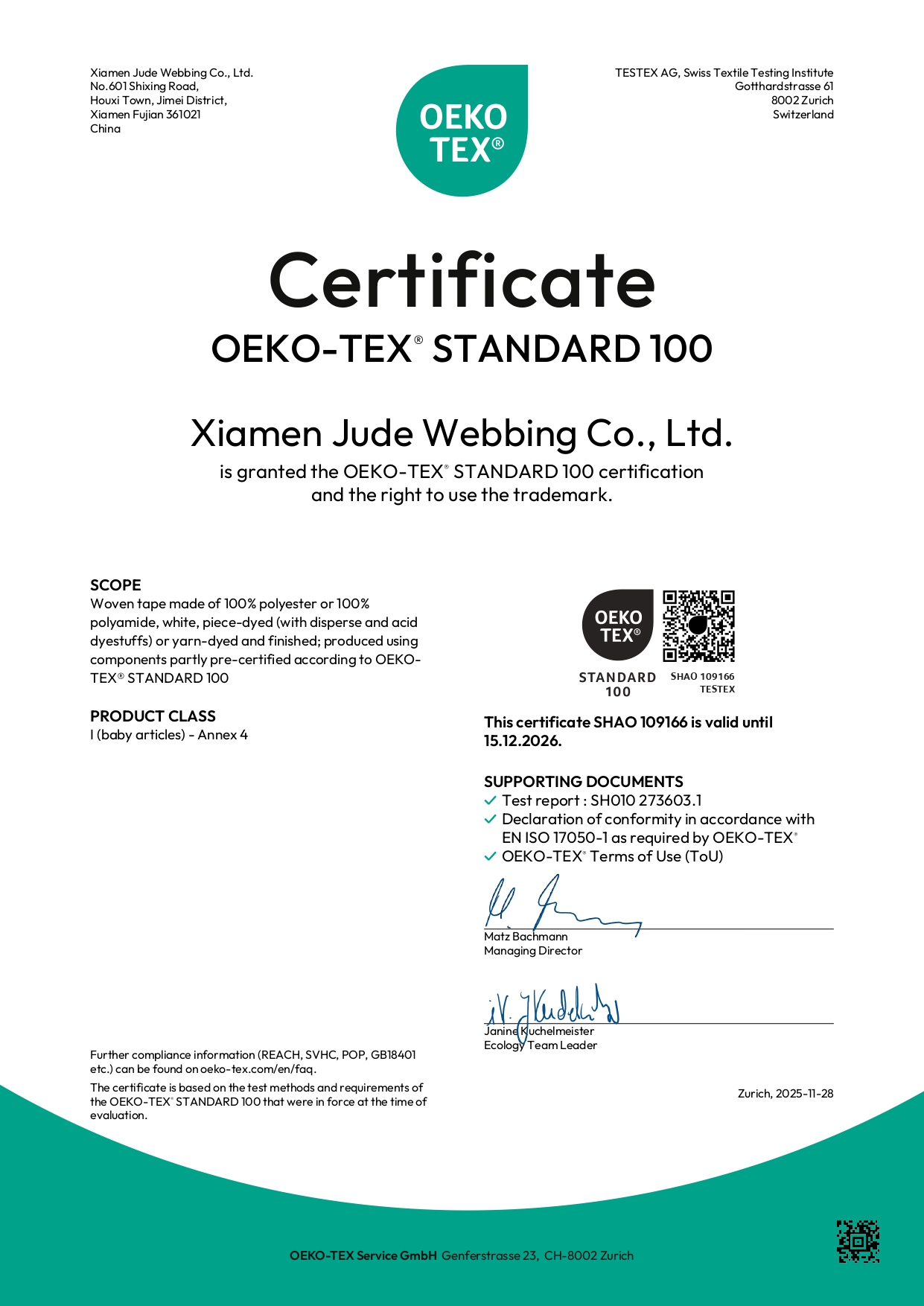
The compliance baseline for a baby-contact strap is OEKO-TEX Standard 100 Class I, the class written for baby articles. JUDECAM holds certificate SH010273603.1, issued by TESTEX AG, Swiss Textile Testing Institute, under OEKO-TEX Standard 100 Class 1, Annex 4, valid to 15 December 2026. The certificate scope matters as much as the class: it covers woven tape made of 100% polyester or 100% polyamide, white, piece-dyed with disperse and acid dyestuffs or yarn-dyed and finished. A buyer choosing a different fibre blend should confirm that the certificate scope still applies.
Alongside that, the supplier holds Bluesign System Partner approval (certificate 027.131.001, issued by bluesign technologies ag, scope webbings and ribbons) and GRS 4.0 certification for recycled constructions, with the GRS scope covering preparatory, weaving, dyeing, finishing and packing. Supporting chemistry documents include an AZO and PCP free report (C50472163, UL), a restricted substances list report for nonylphenol and octylphenol in textiles to EN ISO 21084 (1001380744, UL), and a RoHS report to Directive 2011/65/EU (COBO21080021, COBO Testing Institute).
Cyclic durability: fatigue testing and strength verification
A stroller harness is a repeatedly adjusted mechanism, so stroller webbing is specified with a fatigue test above 10,000 buckle cycles. That number describes the adjustment cycle life of the strap in the buckle, which static pull testing does not capture.
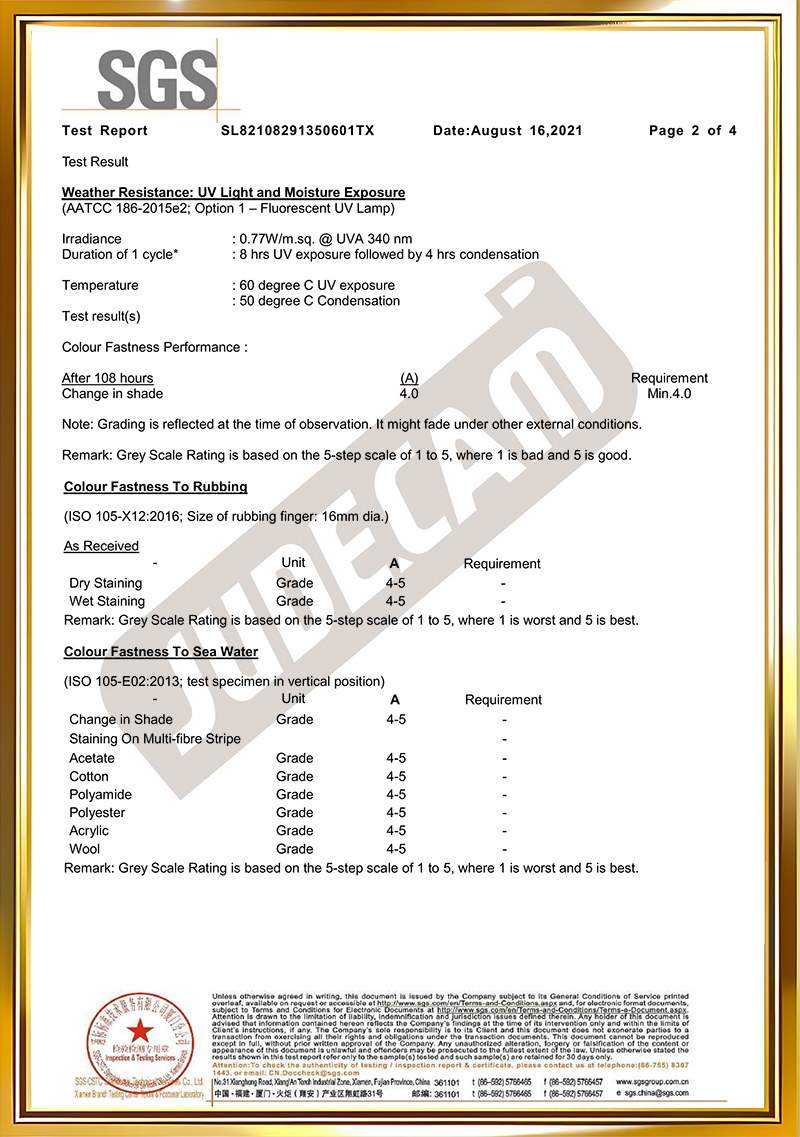
Strength and colour are covered by separate third-party reports. Breaking strength is verified by SGS report SL82308280825301TX under PIA-Test Method-4108A-2005, and colour fastness by SGS report SL82108291350601TX tested to AATCC 186 and ISO 105. Where a flame-retardant specification applies, an SGS flame retardant test report to FAA FAR 25.853 Appendix F Part I(b)(4) vertical test is available; the report lists stroller webbing among the products in scope.
Manufacturing support: OEM and ODM from trial length to bulk
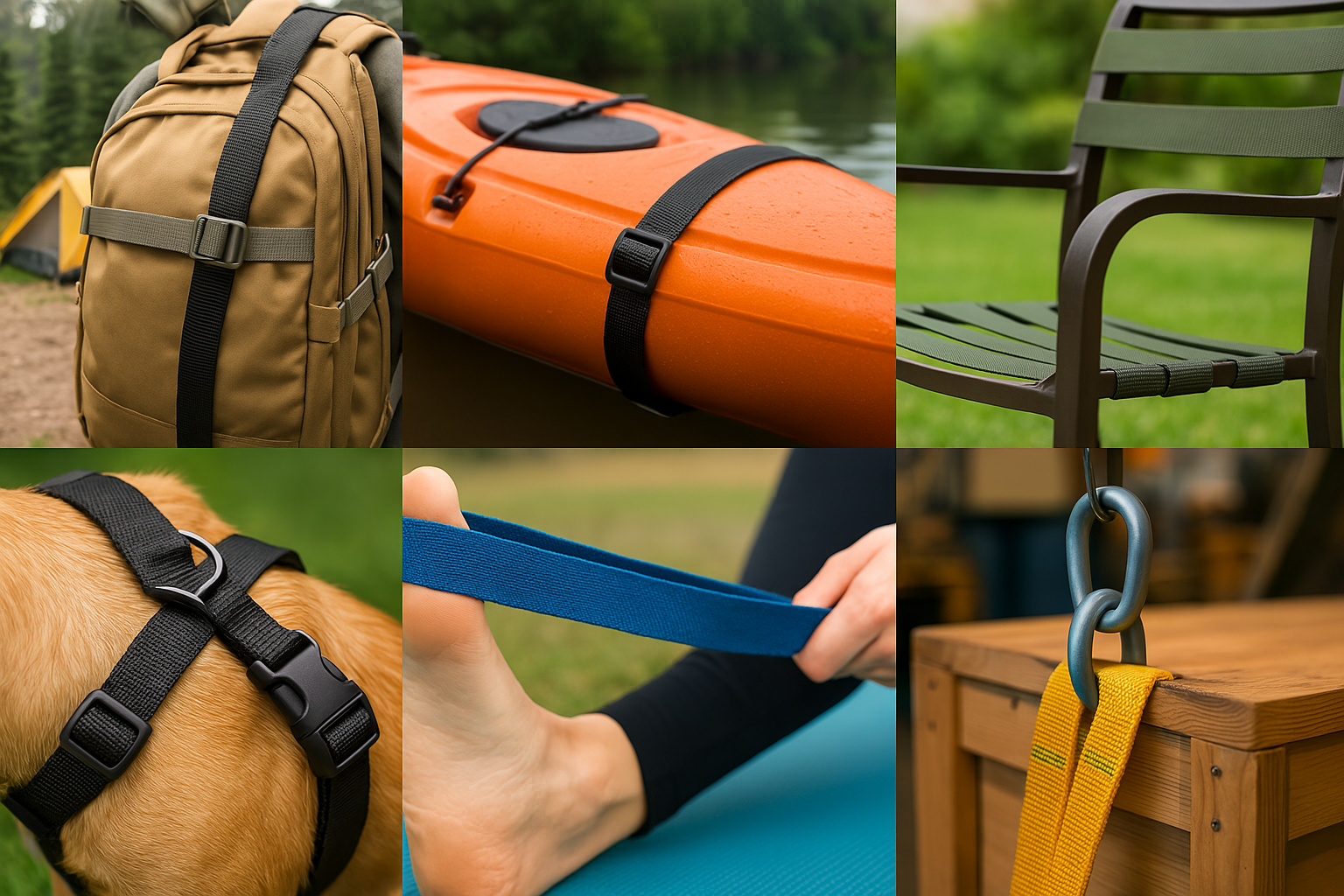
Stroller webbing sits inside the same outdoor and functional webbing platform that JUDECAM runs for outdoor webbing, and that platform is where the customization capacity sits. OEM services cover design customization and branding support; ODM services cover material selection, colour matching and pattern customization. Customization extends to material type, colour, pattern, width, thickness, softness, UV resistance, water-repellent finishing and eco-friendly options. Value-added operations include precision cutting, punching, sewing and finished product assembly for straps, belts and gear components.
The relevant commercial fact for a startup is the minimum order quantity. Webbing is quoted at 3,000 meters per colour per specification, and binding tape at 5,000 meters per colour per specification, with flexible MOQ for trial orders and free samples available for existing stock items. In practice a first stroller model does not have to be launched at volume: a trial length can be produced, assembled into a pre-production unit and evaluated before the 3,000-meter commitment is placed.
Production capacity is approximately 25,000,000 yards per month, with lead time of 7–25 days depending on order size and customization detail. Quality control is a 100% check regime covering durability testing, colour consistency control and material inspection.
How Stroller Webbing Gets Specified: Step by Step
The following sequence is the working order used when a stroller brand, or a brand's assembly partner, develops a new harness or attachment strap. Each step produces a decision that the next step depends on.
STEP 1 — Map the touch points and the load case
List where the strap contacts the child (shoulder, waist, between the legs), where it contacts the adult (adjuster loops, carry handle, recline strap) and where it is anchored. Shoulder and waist contact points drive the edge and softness requirement; anchor points drive the strength requirement.
STEP 2 — Fix width and thickness against the hardware
Select from 20/25/38/50 mm (1/2", 1", 1.5", 2") or specify a custom width, then set thickness — 1.20 mm standard, customizable — so the tape threads the chosen buckle and holds without slipping. Confirm the combination on the actual hardware, not on a drawing.
STEP 3 — Choose the fibre and construction
Decide between high-tenacity polyester and nylon filament, and between plain, twill or other constructions suited to the strap's function. State the fibre explicitly, because the OEKO-TEX certificate scope is tied to the composition declared on it.
STEP 4 — Write the comfort requirement as a specification
Specify rounded edges, soft edge and smooth surface for skin-contact straps. This is the step most often left as a verbal note, and the step most often responsible for a comfort complaint after launch.
STEP 5 — Lock the compliance set
Confirm OEKO-TEX Standard 100 Class I (Baby Safe) for the exact composition, plus Bluesign System Partner and GRS 4.0 where recycled content is claimed. Add chemistry documents — AZO and PCP free, RSL for NP/OP under EN ISO 21084, and RoHS where applicable — to the purchase specification rather than to a separate file.
STEP 6 — Set the validation tests
Agree the test set: fatigue above 10,000 buckle cycles, breaking strength under PIA-Test Method-4108A-2005, colour fastness to AATCC 186 and ISO 105, anti-bacterial testing to AATCC 30-2017 where a hygiene claim is made, and flame retardancy to FAA FAR 25.853 where a flame-retardant specification applies.
STEP 7 — Run a trial batch, then approve against the counter-sample
Produce a trial length inside the flexible MOQ arrangement, assemble it, and approve a pre-production sample. Bulk production is then accepted against counter-sample matching — colour, hand-feel and texture must match the approved sample — with a pre-shipment functionality test of UV resistance, water repellency and other functions to the agreed ISO standards.

Use Cases: Where Stroller Webbing Sits in a Juvenile Product
Stroller webbing is specified for strollers, car seats, infant carriers and high chairs. Within those products, the strap's job changes from position to position, and the specification should change with it.
- Harness shoulder and waist straps. The highest skin-contact exposure in the product. Rounded edges, soft edge and smooth surface matter more here than anywhere else, and the fatigue requirement applies because the harness is adjusted every time a child is seated.
- Crotch and buckle straps. Short, highly loaded and repeatedly threaded. Width and thickness must match the buckle geometry precisely, otherwise the adjuster jams or creeps.
- Recline and tilt adjusters. Functional rather than skin-contact areas, where the priority shifts to consistent hand-feel and colour stability between lots.
- Car seat and infant carrier harnesses. Similar compliance requirements to stroller harnesses, with the addition of flame-retardant specifications in some markets — the FAA FAR 25.853 vertical test report is the relevant reference where that requirement applies.
- High chair restraint straps. A different hygiene profile: straps are exposed to food and repeated wiping, which is where anti-bacterial testing to AATCC 30-2017 and colour fastness to washing become relevant.
- Canopy, basket and accessory attachment loops. Low skin contact, higher handling exposure, so abrasion and colour consistency drive the choice.
Stroller Webbing at a Glance: Specification and Verification
The first table maps the decision areas a buyer has to close, against the verified reference points for this product. It is not a ranking against other suppliers; it is the specification set that a purchase order should reflect.
| Selection area | What to lock down | Stroller Webbing reference point |
|---|---|---|
| Base material | Fibre type declared on the certificate | 100% High-Tenacity Polyester / Nylon Filament |
| Width | Buckle and pad geometry | 20 / 25 / 38 / 50 mm (1/2", 1", 1.5", 2"), customized |
| Thickness | Buckle clearance and hand-feel | 1.20 mm, customized |
| Edge and surface | Skin contact comfort | Rounded edges, soft edge, smooth surface, child-safe |
| Cyclic durability | Harness adjustment life | Fatigue test >10,000 buckle cycles |
| Skin safety | Baby-contact compliance | OEKO-TEX Standard 100 Class I (Baby Safe), certificate SH010273603.1 |
| Recycled option | Recycled content claim | GRS 4.0 certification with transaction certificate support, 50%–100% recycled content on GRS webbing |
| Packaging | Line-side handling | 50 meters per roll |
| Order size | Trial batch vs. bulk | 3,000 m per colour per specification; trial orders supported |
| Lead time | Launch schedule | 7–25 days depending on order size and customization |
The second table lists the documents a buyer should receive with the quotation, so that the compliance file is complete before sampling starts.
| Document | Reference | Issuer | Method / scope | Issue date |
|---|---|---|---|---|
| OEKO-TEX Standard 100 Class I | SH010273603.1 | TESTEX AG | Woven tape, 100% polyester or 100% polyamide, Annex 4 baby articles | 2025-11-28 |
| GRS 4.0 certificate | SGC-GRC03622-GRS-2025-07 | SGS | Preparatory, weaving, dyeing, finishing, packing | 2025-07-29 |
| Bluesign System Partner | 027.131.001 | bluesign technologies ag | Webbings / ribbons | 2026-01-05 |
| Breaking strength test report | SL82308280825301TX | SGS | PIA-Test Method-4108A-2005 | 2023-05-31 |
| Colour fastness test report | SL82108291350601TX | SGS | AATCC 186, ISO 105 | 2021-08-16 |
| Anti-bacterial test report | SL819082304721TX | SGS | AATCC 30-2017, Test III, Aspergillus niger ATCC 6275 | 2019-05-23 |
| Flame retardant test report | — | SGS | FAA FAR 25.853 Appendix F Part I(b)(4) vertical test | 2018-10-31 |
| AZO & PCP free report | C50472163 | UL | Chlorinated phenols (PCP) and azo dye test | 2021-08-10 |
| RSL report | 1001380744 | UL | NP / OP in textiles, EN ISO 21084 | 2021-11-26 |
| RoHS report | COBO21080021 | COBO Testing Institute | Directive 2011/65/EU | 2021-08-02 |
| ISO 9001:2015 | 00224Q22797R0M | CQM | Design and processing of functional webbing | 2024-05-21 |
| ISO 14001:2015 | 00224E31944R0M | CQM | Environmental management, webbing | 2024-01-21 |
| ISO 45001:2018 | 00224S21758R0M | CQM | Occupational health and safety, webbing | 2024-05-21 |
Frequently Asked Questions
1. Which certifications should stroller webbing carry for baby-contact use?
The baseline is OEKO-TEX Standard 100 Class I, the class written for baby articles. JUDECAM holds certificate SH010273603.1 issued by TESTEX AG, Swiss Textile Testing Institute, valid to 15 December 2026, covering woven tape made of 100% polyester or 100% polyamide, white, piece-dyed or yarn-dyed and finished. On top of that, Bluesign System Partner approval (027.131.001), GRS 4.0 certification for recycled constructions, an AZO and PCP free report (C50472163, UL) and an RSL report for NP and OP to EN ISO 21084 (1001380744, UL) are available. Because certificates are scope- and cycle-limited, confirm the current version in the issuing body's database and check the declared fibre composition before bulk release.
2. Can width, thickness, softness and colour be customized for a new stroller model?
Yes. Standard widths are 20/25/38/50 mm, equivalent to 1/2", 1", 1.5" and 2", with customized widths available; standard thickness is 1.20 mm, also customizable. Customization covers material type, colour, pattern, width, thickness, softness, UV resistance, water-repellent finishing and eco-friendly options. OEM services include design customization and branding support, and ODM services include material selection, colour matching and pattern customization. Value-added operations cover precision cutting, punching, sewing and finished product assembly. Production capacity is approximately 25,000,000 yards per month.
3. What is the minimum order quantity, and how do trial orders work?
Webbing is quoted at 3,000 meters per colour per specification, and binding tape at 5,000 meters per colour per specification, with flexible MOQ for trial orders and free samples available for existing stock items. For a startup developing a first stroller, that structure allows a small trial length to be produced and assembled into a pre-production unit before the full 3,000-meter commitment is placed.
4. How do I validate a sample before bulk production?
Approval runs on two mechanisms. Counter-sample matching requires bulk production to match the approved pre-production sample in colour, hand-feel and texture. A pre-shipment functionality test verifies UV resistance grade, water repellency and other functions according to the agreed ISO standards. These sit on top of the supplier's 100% quality check regime, which covers durability testing, colour consistency control and material inspection.
5. How long does production and delivery take?
Lead time is 7–25 days depending on order size and customization detail. Delivery terms are flexible and include FOB, CIF, DAP and DDP by sea, air or express for urgent needs, and payment terms are T/T (30% deposit, 70% before shipment) or confirmed L/C at sight. To move a stroller programme forward, send the width, thickness, fibre, colour reference and target certification set to judecam@judegroup.com and request a trial-length quotation with the matching certificate pack.
Conclusion: Buy Stroller Webbing as a Documented Component
Stroller webbing is not a generic strap cut to length. It is a juvenile component that has to be strong enough for a harness, soft enough for a child's shoulder, chemically clean enough for baby contact, and documented well enough to survive a compliance review. Those four requirements are decided by fibre, dimensions, edge treatment, cyclic durability and the certificate scope — not by price per meter alone.
For a startup or a brand entering the stroller category, the practical route is to specify first, then sample: fix the width and thickness against the hardware, write the softness requirement as a specification, lock OEKO-TEX Standard 100 Class I and the relevant chemistry documents, agree the test set, and approve a trial batch against a counter-sample. A 3,000-meter minimum order quantity per colour per specification, with trial-order flexibility, means that sequence can be run at development scale rather than at launch scale.
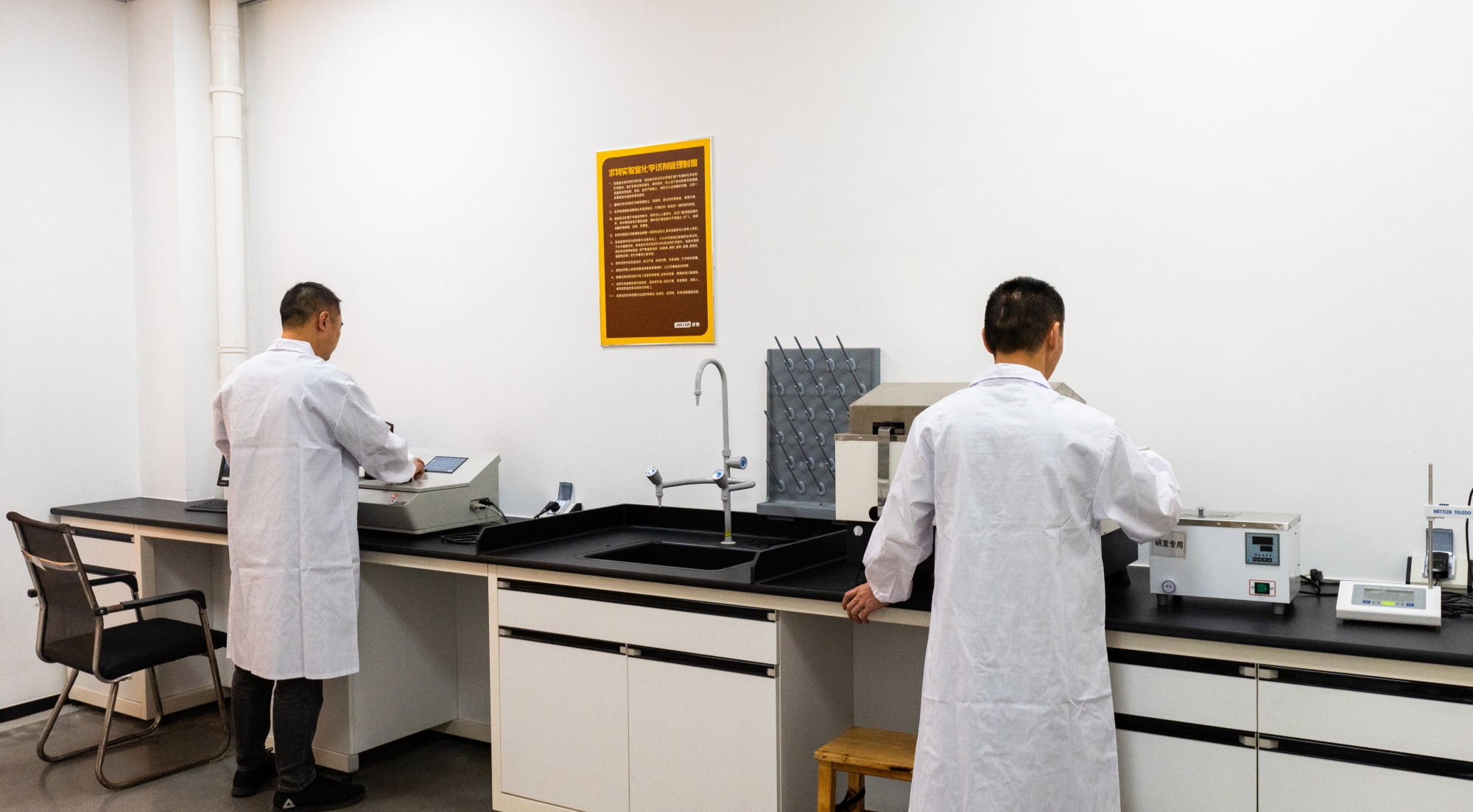
Next step: request a stroller webbing sample and specification sheet.
Send your target width, thickness, fibre, colour reference and certification requirement, and JUDECAM will return a trial-length quotation with the matching certificate pack.
Email: judecam@judegroup.com | Tel: 86-592-6361058 | WhatsApp: +86 13358399583 | www.judewebbing.com
Xiamen Jude Webbing Co., Ltd. — No. 601 ShiXing Road, Jimei District, Xiamen, 361024, China.
Have Questions or Need More Details?
Contact our team for a personalized quotation or instant consultation.
Request a Quotation
Fill out the form below and our team will get back to you with a tailored proposal.
WhatsApp Direct Chat
Prefer to chat in real-time? Message us on WhatsApp for instant assistance & quick answers.
- Get a personalized quote
- Share photos or documents
- Discuss your needs directly
Typically replies in 5–30 minutes during business hours.