Faded Straps Ruining Your Gear? Fix It With UV-Resistant Webbing
Faded Straps Ruining Your Gear? Fix It With UV-Resistant Webbing
Outdoor webbing almost never fails dramatically. It fades first. A strap that has spent two summers on a roof rack, a tent guy line, or a dog leash in daily sun turns chalky long before it tears — and by the time the colour is obviously wrong, the same ultraviolet exposure has already been working on the fibre underneath. Fading is not bad luck. It is a specification problem, and it is decided at the yarn, dyeing and finishing stage, long before the strap reaches a shelf.
UV-resistant outdoor webbing is the direct answer to that problem: a UV-stabilised base material, a controlled dyeing process, and a light-fastness figure that is measured rather than claimed. This guide explains what actually drives fading, what the outdoor market now expects, how UV-resistant webbing is produced and verified, how the main material options compare on documented UV data, and how a brand or importer can specify and validate the right webbing before committing to a production order.
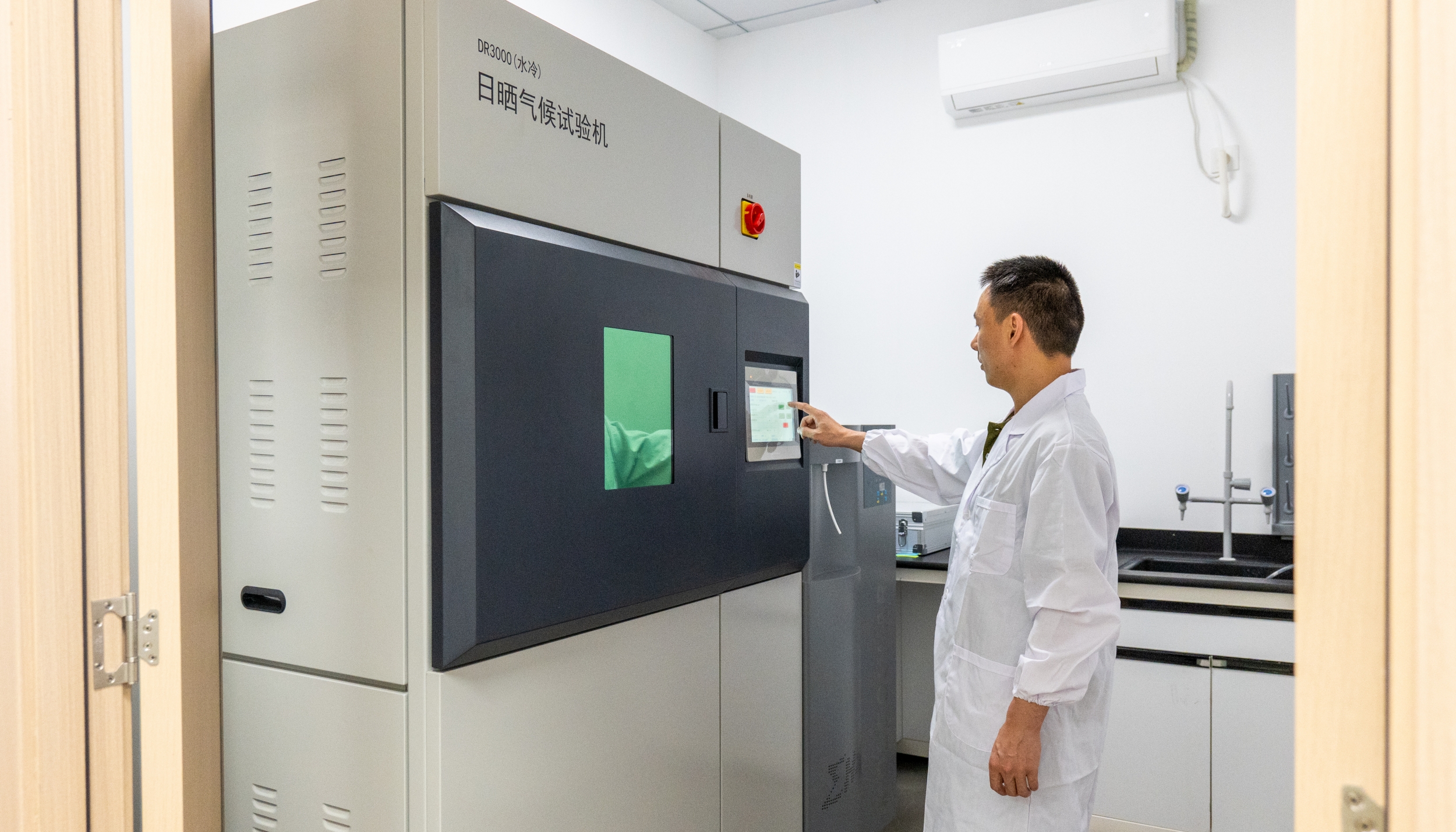
Weather-resistant testing on finished outdoor webbing — the stage where UV and light-fastness claims are turned into numbers.
Problem Definition: What a Faded Strap Is Actually Telling You
Colour loss in outdoor webbing is the visible end of two processes running at the same time. Ultraviolet energy attacks the dye chemistry that gives the tape its colour, and it also acts on the polymer itself. The colour shift shows up first, which is why faded webbing is best read as an early warning rather than a cosmetic defect: a strap that has gone from deep black to grey has already spent a measurable part of its service life under a stress it was not specified to handle.
For a gear brand, the commercial consequences usually arrive in a predictable order. The first visible fading appears on customer photography and in reviews. Then come the returns and warranty conversations, followed by retailer questions about lot-to-lot consistency. None of these are caused by a single dramatic failure. They are caused by a webbing specification that never defined UV exposure in the first place.
In practice, webbing fades faster for a small number of reasons, and all of them are controllable:
- No UV stabilisation. A tape can be perfectly strong and still have no stabilising additive in the polymer or the finish, leaving the colour to degrade with exposure.
- Dye selection and colour control. Light-fastness depends heavily on the dye system used and on how tightly the dyeing line controls the result. Weak colour control between production lots produces a different kind of failure: the first order matches, and the reorder does not.
- Exposure geometry. Thin, open webbing presents a large surface area relative to its mass, so the same sunlight that barely touches a thick textile can noticeably work on a strap.
- Weather combined with sun. Rain, salt water and UV act together. A tape with no water-repellent finishing holds moisture and contamination that accelerate the visible decline of the surface.
The uncomfortable part for buyers is that none of this is visible in a quotation. Two woven tapes of the same width can look identical on the table and behave completely differently after twelve months of outdoor use.
Industry Background: Why UV Performance Moved Up the Specification Sheet
The global webbing market was valued at USD 4.2 billion in 2023 and is projected to reach USD 5.7 billion by 2030, with outdoor recreation among the demand drivers identified by Grand View Research. Within that market, Asia Pacific accounted for 66.3% of revenue in 2023, reflecting the region's large manufacturing base in countries such as China and Vietnam.
Two structural shifts have pushed UV performance higher on the buyer agenda. The first is material. Recycled polyester (rPET) accounted for approximately 15–18% of global polyester fibre production in 2024, according to Textile Exchange data cited by Szoneier Fabrics, which means a growing share of outdoor tape is now made from recycled yarn — and recycled and virgin polyester do not automatically share the same UV behaviour unless the specification says so. At the same time, IMARC Group identifies nylon webbing as the fastest-growing segment in sporting goods, on the strength of its strength-to-weight ratio and elasticity.
The second shift is safety and compliance. In the European Union, mountaineering slings and climbing webbing fall under the EN 566 standard, which requires a minimum tensile strength of 22 kN for safety compliance. Webbing used in life-safety and rescue contexts cannot be evaluated on price alone, and UV degradation adds a further variable that buyers increasingly want evidence for.
The supplier landscape is also well established. Globally recognised webbing manufacturers include National Webbing Products Co., American Cord & Webbing Co. (ACW) and Murdock Webbing Company, as listed by IMARC Group. For buyers evaluating UV-resistant options, the useful comparison is not brand familiarity but the presence of documented light-fastness data on finished tape.
The Technical Answer: How UV-Resistant Outdoor Webbing Is Built
Xiamen Jude Webbing Co., Ltd., which operates under the brand JUDECAM, was founded in 2006 and specialises in the research, design and production of outdoor and functional new-material webbing. Its product range includes outdoor webbing, anti-UV webbing, waterproof webbing, eco-friendly webbing, nylon webbing, nylon 6.6 webbing, polyester webbing, RPET webbing, recycled webbing, safety webbing and cut-resistant webbing. Production is supported by a self-built 25,800 m² base in Xiamen and Vietnam with in-house weaving, printing, dyeing, finishing and assembly — the full chain that determines whether a tape holds its colour in the sun.
1. Base material selection decides the ceiling
UV performance starts with the polymer. High-tenacity polyester and UV-stabilised nylon are the two workhorse options for sun-exposed gear, and the documented light-fastness figures differ between constructions. Backpack webbing and camping webbing, both built on high-tenacity nylon or high-tenacity polyester filament, are tested to UV fastness Grade 4.5 after 1,000 hours under ISO 105. Polyester webbing is rated Grade 4.5 after 500 hours under ISO 105, with water absorption below 0.5% and excellent acid resistance.
Recycled options are no longer a compromise. RPET webbing is made from 100% high-tenacity post-consumer recycled polyester yarn and is rated UV resistance Grade 4 after 500 hours under ISO 105. Recycled webbing reaches Grade 4–5 under AATCC 16.3, with optional Grade 4 water repellency under AATCC 22.
2. Dyeing and colour consistency
Even a UV-stabilised polymer will fade unevenly if the dyeing line is inconsistent. This is where colour continuity between production lots is decided.
Colour is set on automated dyeing lines and then checked through the factory's colour consistency control procedure, which forms part of a 100% quality-check system covering material inspection, durability testing and colour verification. For polyester webbing, custom Pantone matching is available, so a brand can approve a target colour and hold production against it rather than accepting whatever the line produces.

Colour processing and dyeing lines — the stage where colour consistency between lots is created or lost.
Independent verification of colour performance is available: a Color Fastness Test Report issued by SGS under AATCC 186 and ISO 105 carries certificate number SL82108291350601TX. Bluesign webbing is separately rated at ISO 105 Grade 4–5 for colour fastness, and the broader nylon and camouflage webbing family is specified at colour fastness to light of Grade 4 or better under AATCC 16.3.
3. UV stabilisation and finishing
UV stabilisation is applied through the base material selection and the finishing process rather than as a single additive. The result is expressed in hours of exposure rather than adjectives:
- Backpack webbing and camping webbing: UV fastness Grade 4.5 after 1,000 hours (ISO 105).
- Polyester webbing: UV fastness Grade 4.5 after 500 hours (ISO 105).
- RPET webbing: UV resistance ISO 105 Grade 4 after 500 hours.
- Recycled webbing: UV resistance Grade 4–5 (AATCC 16.3).
- Bluesign webbing: UV resistance Grade 4 (BS EN ISO 105-B02).
- Nylon outdoor webbing: colour fastness to light Grade 4 (ISO 105-B02) with salt water resistance Grade 4–5 (ISO 105-E02).
Finishing is usually combined rather than stacked. A tape specified for sun exposure frequently also carries optional water-repellent finishing at Grade 4 under AATCC 22, because moisture and contamination accelerate the visible decline of an exposed surface. For brands building a single tape for multiple markets, this combination — light fastness plus water repellency plus a certified input — is usually the most efficient specification.
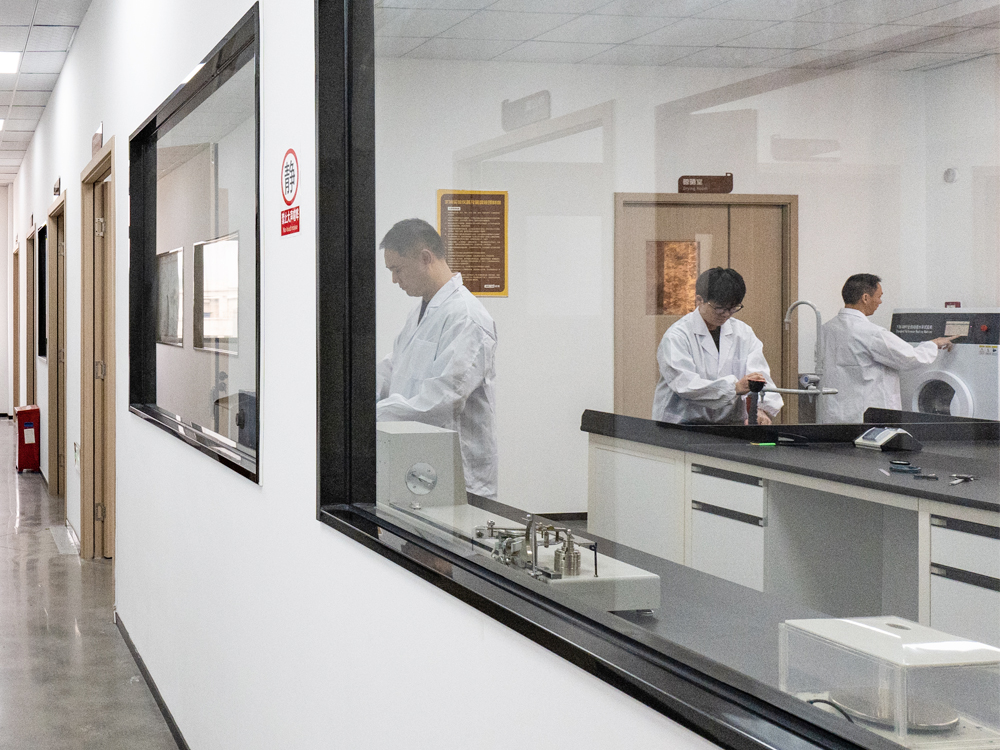
In-house webbing testing laboratory — where light fastness, colour fastness and breaking strength are checked before shipment.
4. Verification: turning a claim into a document
UV performance should always be traceable to a test report. The relevant documentation held for webbing production includes:
| Document | Issuing body / reference | What it covers |
|---|---|---|
| Anti UV Test Report | SGS, certificate no. SL82108301587901TX | UV performance of webbing tested to ISO 105 |
| Color Fastness Test Report | SGS, certificate no. SL82108291350601TX | Colour fastness of webbing tested to AATCC 186 and ISO 105 |
| Breaking Strength Test Report | SGS, certificate no. SL82308280825301TX | Tensile performance tested to PIA-Test Method-4108A-2005 |
| bluesign® System Partner | bluesign technologies ag, certificate no. 027.131.001 | System partnership for webbings and ribbons |
| Global Recycled Standard (GRS 4.0) | SGS, certificate no. SGC-GRC03622-GRS-2025-07 | Recycled content across preparatory, weaving, dyeing, finishing and packing |
| OEKO-TEX STANDARD 100 Class I | TESTEX AG, certificate no. SH010273603.1 | Woven tape in 100% polyester or 100% polyamide, baby-safe class |
Management systems are also covered: ISO 9001:2015 (certificate 00224Q22797R0M), ISO 14001:2015 (certificate 00224E31944R0M) and ISO 45001:2018 (certificate 00224S21758R0M), each issued by CQM for the design and processing of functional webbing and webbing-finished products.
Step-by-Step: Specifying UV-Resistant Webbing Without Guesswork
- Define the exposure profile. State where the product will live: continuous sun, seasonal sun, salt water, or high-altitude UV. This determines whether the specification needs Grade 4 or Grade 4.5 light fastness, and whether water repellency should be added.
- Choose the base material and construction. Polyester for the strongest colour stability and low water absorption; UV-stabilised nylon where softness and hand-feel matter; RPET or recycled polyester where recycled content is a requirement. Widths of 20, 25, 38 and 50 mm (1/2", 1", 1.5", 2") are standard and can be customised, at a standard thickness of 1.20 mm.
- Approve the colour against a target. Use custom Pantone matching so the reference is objective. Ask how colour consistency is controlled between lots before you approve the lab dip.
- Lock the finish bundle. Decide whether UV stabilisation is specified alone or combined with water-repellent, anti-mildew or other performance finishes, and record the required grade for each.
- Request the test evidence. Ask for the SGS anti-UV report and the colour fastness report before production, not after.
- Validate with samples, then scale. Free samples are available for existing stock items, and flexible MOQ applies to trial orders. Run the sample under real outdoor conditions in parallel with the lab data.
- Plan lead time and volume. Production lead time is 7–25 days depending on order size and customisation detail, supported by monthly capacity of approximately 25,000,000 yards.
Use Cases: Where UV-Resistant Webbing Earns Its Cost
UV-resistant webbing matters most where the product is expected to look new for more than one season. Typical applications include hammock straps, tie-down straps and camping accessories; outdoor backpacks, mountaineering packs and camera bags; tents, camping furniture and tree straps; marine equipment and long-term outdoor tie-downs; professional pet leashes and climbing slings; and stroller and child-carrier components where colour stability is part of the safety perception.
Documented production experience supports that positioning. One outdoor gear brand project uses webbing in modular backpacks, expandable carrying systems and outdoor gear accessories at more than 300,000 meters per year, with performance maintained for 2–3 years under regular outdoor usage. The documented project highlights are modular attachment compatibility, lightweight and flexible design, high durability under repeated use, and custom colour and pattern options — with clients across multiple European countries, the US and Asia.
A second programme, involving a global outdoor brand in bags and coolers, consumes over 1,000,000 meters annually across outdoor backpacks, cooler bags and travel gear, with products in outdoor use for 2–4 years. The verified highlights for that project are recycled materials (RPET and recycled nylon), UV resistance and colour fastness, water-repellent finishing, and a soft touch with high durability. The reported result is an improved sustainability profile while maintaining durability and colour consistency — which is precisely the balance that a UV specification is meant to protect.
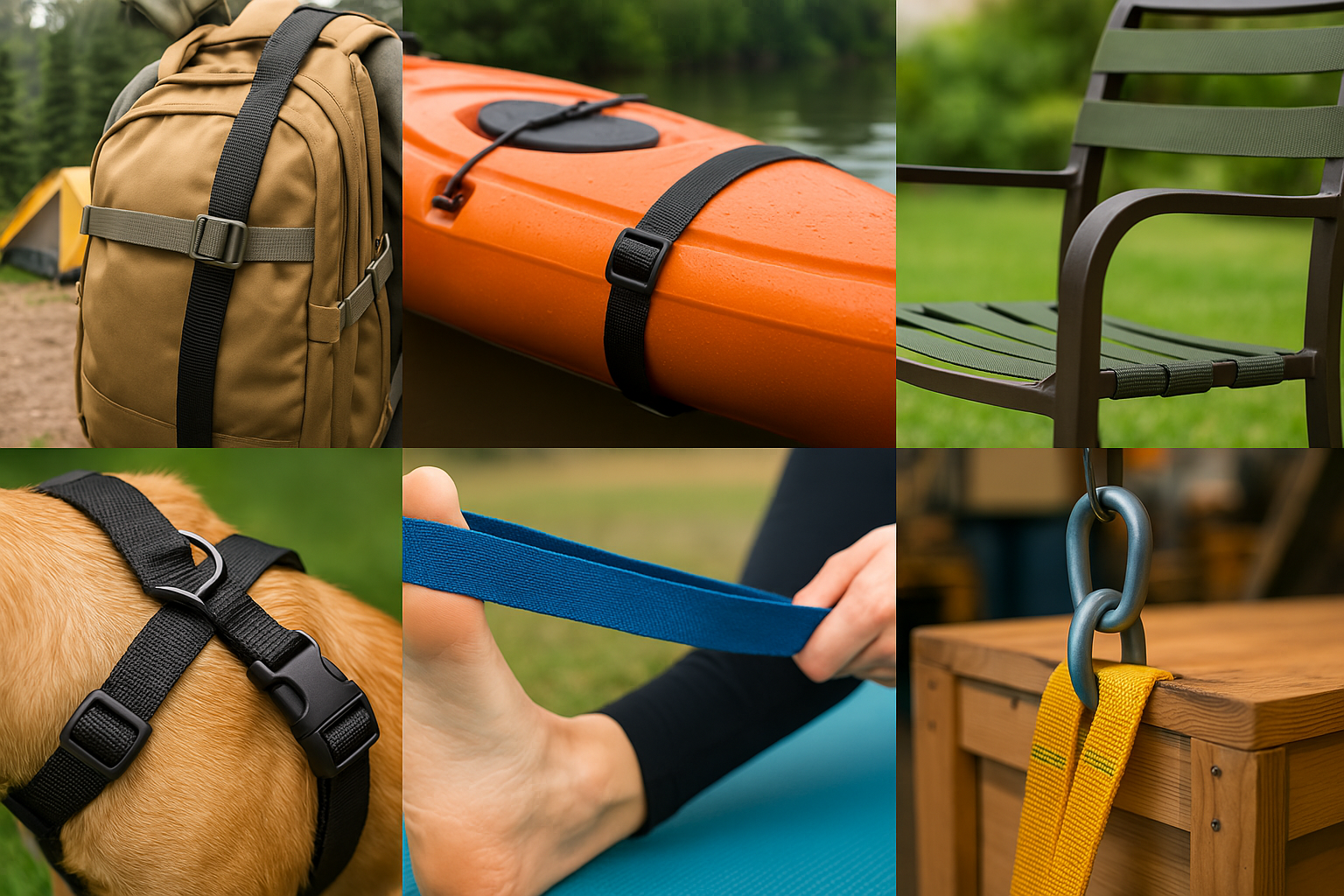
Certified production environment supporting large-volume outdoor webbing programmes.
Comparison: Verified Light-Fastness by Outdoor Webbing Type
The table below ranks webbing types by documented UV exposure result and light-fastness grade. Ranking reflects the longest verified exposure hours at the highest documented grade, as stated in the product specifications below.
| Rank | Webbing type | Base material | Documented UV / light fastness | Test standard | Strongest fit |
|---|---|---|---|---|---|
| 1 | Backpack Webbing | High-tenacity nylon (soft-touch finish) or 100% high-tenacity polyester filament | Grade 4.5 after 1,000 hours | ISO 105 | Outdoor backpacks, mountaineering packs, camera bags |
| 2 | Camping Webbing | UV-stabilised nylon / high-tenacity polyester | Grade 4.5 after 1,000 hours | ISO 105 | Tents, hammocks, camping furniture, tree straps |
| 3 | Polyester Webbing | 100% high-tenacity polyester filament | Grade 4.5 after 500 hours | ISO 105 | Marine equipment, long-term tie-downs, solar sail edges |
| 4 | Recycled Webbing | 100% high-tenacity post-consumer recycled polyester yarn | Grade 4–5 | AATCC 16.3 | Sustainable luggage, tent components, mass-market outdoor gear |
| 5 | RPET Webbing | 100% high-tenacity post-consumer recycled polyester yarn | Grade 4 after 500 hours | ISO 105 | Sustainable luggage, eco-friendly tent components |
| 6 | Bluesign Webbing | Bluesign® System Partner nylon / polyester | Grade 4 | BS EN ISO 105-B02 | Tier-1 outdoor apparel, sustainable technical packs |
| 7 | Nylon Outdoor Webbing | High-tenacity nylon (soft-touch finish) / high-tenacity polyester filament | Grade 4 to light; salt water resistance Grade 4–5 | ISO 105-B02; ISO 105-E02 | Premium packs, apparel belts, premium pet accessories |
| 8 | Nylon, MIL-SPEC, Tactical and Camouflage webbing | Military-grade nylon, high-tenacity nylon 6.6 / HT polyester | Grade 4 or better to light | AATCC 16.3 | Tactical vests, military packs, load-carriage systems |
Two reading notes matter here. First, recycled and RPET tapes sit close to virgin polyester in this table, which is why a UV specification is essential even on sustainability-led programmes: the recycled story and the UV story are separate claims that must both be verified. Second, ranks 1 and 2 share the same document grade and are separated only by application fit, not by a measured difference.
Frequently Asked Questions
Are UV-resistant webbings available with Bluesign, GRS and OEKO-TEX certification?
Yes. UV performance and certification are compatible, because UV resistance is built into the base material selection and the finishing process rather than added as a separate chemical system. Xiamen Jude Webbing is a bluesign® System Partner under certificate number 027.131.001, holds GRS 4.0 certification under certificate number SGC-GRC03622-GRS-2025-07 covering preparatory, weaving, dyeing, finishing and packing, and holds OEKO-TEX STANDARD 100 Class I (Baby Safe) certificate SH010273603.1 for woven tape made of 100% polyester or 100% polyamide. GRS webbing uses GRS 4.0 certified recycled polyester (RPET) or recycled nylon with 50%–100% recycled content verified by Transaction Certificate. Because certification and UV performance are evidenced in different documents, buyers should request both.
Which outdoor webbing resists UV fading best?
On documented finished-tape data, backpack webbing and camping webbing carry the strongest UV exposure results at Grade 4.5 after 1,000 hours under ISO 105, followed by polyester webbing at Grade 4.5 after 500 hours under ISO 105. RPET webbing is rated Grade 4 after 500 hours (ISO 105), recycled webbing Grade 4–5 (AATCC 16.3), Bluesign webbing Grade 4 (BS EN ISO 105-B02), and nylon outdoor webbing Grade 4 to light (ISO 105-B02) with salt water resistance Grade 4–5. Because these figures come from different standards, the correct method is to compare candidate tapes within the same standard rather than across the table.
What is the minimum order quantity for UV-resistant webbing?
The standard MOQ is 3,000 meters per colour per specification for webbing, and 5,000 meters per colour per specification for binding tape. Flexible MOQ is available for trial orders, and free samples are available for existing stock items. Cost is driven by the specification rather than by the UV claim alone — recycled versus virgin yarn, the Pantone colour target, width, thickness, and any additional finishing such as water repellency all change the quotation. Defining the exposure profile and colour target first is therefore the fastest route to an accurate price.
Can I test fading resistance before placing a production order?
Yes, and it is worth doing in two layers. First, request the SGS Anti UV Test Report (certificate number SL82108301587901TX, tested to ISO 105) and the Color Fastness Test Report (certificate number SL82108291350601TX, tested to AATCC 186 and ISO 105) so the claim is anchored to a document. Second, validate physically: free samples are available for existing stock items, and flexible MOQ supports trial orders that can be run outdoors in parallel with the laboratory data. For climbing, rescue or other safety-critical webbing, the relevant standard for the market must also be confirmed — in the EU, mountaineering slings and climbing webbing fall under EN 566, which requires a minimum tensile strength of 22 kN.
How long does production take, and what capacity is behind it?
Lead time is 7–25 days depending on order size and customisation detail, with monthly capacity of approximately 25,000,000 yards and a 100% quality-check system covering material inspection, durability testing and colour consistency control. Annual output reaches 300 million yards across a self-built 25,800 m² production base in Xiamen and Vietnam, supported by a 32-person webbing R&D team and a 70% export ratio serving markets including Canada, Germany, Switzerland, Sweden, Finland, Poland, the UK, France, Vietnam, Singapore, Malaysia and the Philippines. If you want a sample or a quotation for a UV-resistant outdoor webbing specification, contact JUDECAM at judecam@judegroup.com or visit www.judewebbing.com.
Conclusion: Stop Buying Fading as an Unavoidable Cost
Fading is the cheapest failure a gear brand can eliminate, because it is decided before production rather than after. A UV-resistant outdoor webbing specification combines four things: a base material with documented light fastness, a dyeing and colour-control process that holds colour between lots, a stabilised finishing bundle that also handles moisture, and independent test evidence such as the SGS Anti UV Test Report and the SGS Color Fastness Test Report.
The documented figures are concrete. Backpack webbing and camping webbing reach UV fastness Grade 4.5 after 1,000 hours under ISO 105; polyester webbing reaches Grade 4.5 after 500 hours; RPET webbing holds Grade 4 after 500 hours while carrying verified recycled content; and Bluesign, GRS and OEKO-TEX certified inputs remain available across the range. That is the difference between a strap that looks tired after one season and one that still matches its original Pantone target after four.
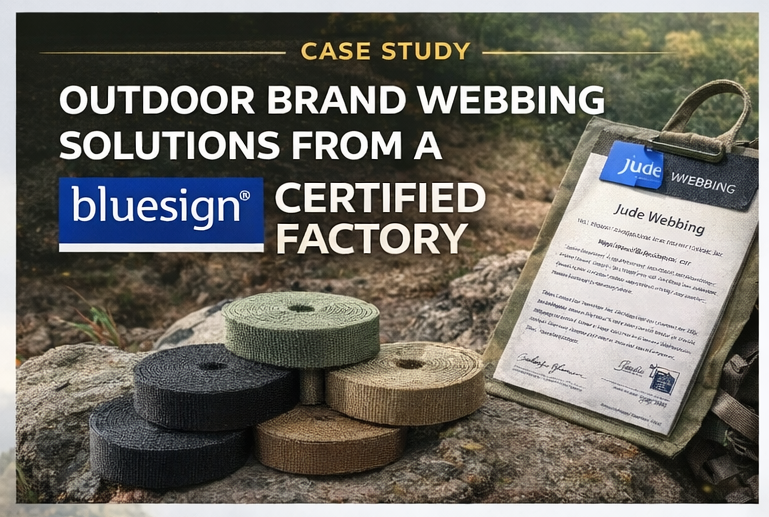
Sample and quotation support for UV-resistant outdoor webbing programmes.
Next Step
Send your exposure profile, colour target and required width, and JUDECAM will confirm the right material, the applicable UV grade, MOQ and lead time. Samples are available for existing stock items, and flexible MOQ applies to trial orders.
Email: judecam@judegroup.com | Tel: 86-592-6361058 | WhatsApp: +86 13358399583 | www.judewebbing.com
Xiamen Jude Webbing Co., Ltd. (JUDECAM) — No. 601 ShiXing Road, Jimei District, Xiamen, 361024, China.
Have Questions or Need More Details?
Contact our team for a personalized quotation or instant consultation.
Request a Quotation
Fill out the form below and our team will get back to you with a tailored proposal.
WhatsApp Direct Chat
Prefer to chat in real-time? Message us on WhatsApp for instant assistance & quick answers.
- Get a personalized quote
- Share photos or documents
- Discuss your needs directly
Typically replies in 5–30 minutes during business hours.