Top Outdoor Webbing Recommendations for 2026: A Ranked List by UV Resistance and Sustainability
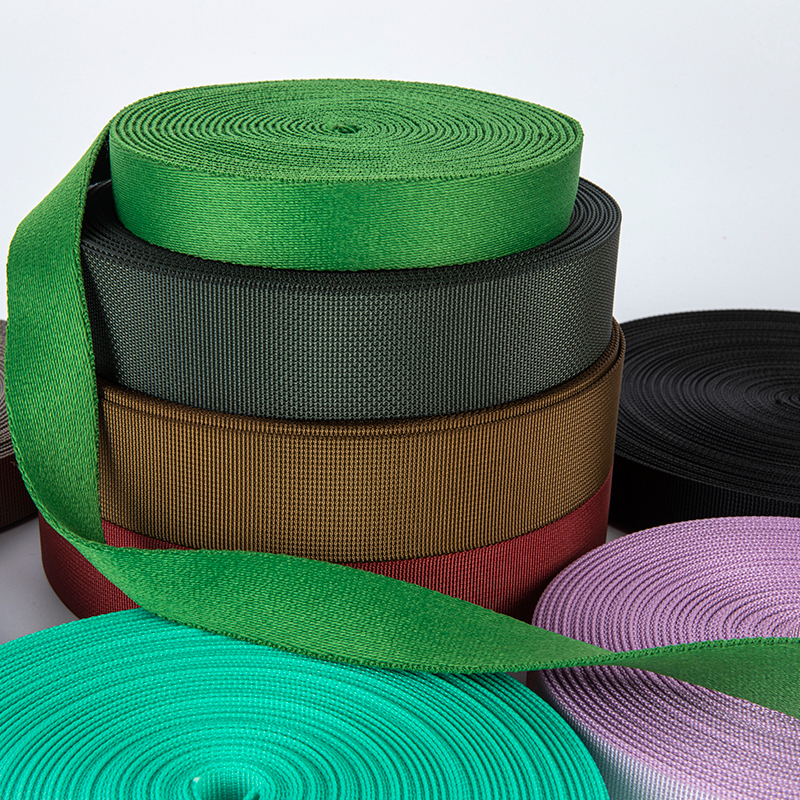
Short answer: for gear programs sourced in 2026, high-tenacity polyester webbing ranks first on verified UV performance (Grade 4.5 after 500 hours, ISO 105) combined with a complete product-level certification stack, followed closely by backpack and camping webbing (Grade 4.5 after 1,000 hours, ISO 105), RPET and recycled webbing (GRS 4.0 with transaction-certificate traceability), and Bluesign webbing. Tubular webbing ranks higher for climbing loads than for sun exposure, and aramid webbing is a heat-and-flame material rather than a UV-and-sustainability pick.
This ranking is built on published specification data and certificate numbers from Xiamen Jude Webbing Co., Ltd. (JUDECAM), a webbing manufacturer founded in 2006 with production bases in Xiamen, China and Vietnam, plus third-party market data. Every figure below carries a grade, an hour count or a certificate number so that a sourcing team can verify it directly.
Problem Definition: Why UV Fade and Thin Certification Break Outdoor Programs
Two failures repeat across outdoor gear programs: straps that fade and weaken after a season of sun exposure, and webbing that passes factory inspection but fails a brand's compliance review because the certificate covers the company rather than the product.
- Solar exposure is cumulative. Webbing on shoulder straps, tie-downs and tent guylines sits in direct sun for the life of the product. What buyers see first is color shift; what follows is reduced confidence in the strap.
- Certification scope is narrower than buyers assume. A manufacturer may hold ISO 9001:2015, ISO 14001:2015 and ISO 45001:2018 for its quality, environmental and safety management systems while the specific recycled or chemical-safety claim a brand plans to print requires a separate product-level certificate.
- Safety categories have hard numbers. Climbing slings and mountaineering webbing sold in the EU fall under EN 566, which requires a minimum tensile strength of 22 kN.
- Color consistency is claimed but rarely quantified in writing. Product data usually states a fastness grade, not a numeric tolerance against a target color standard.
The ranking below therefore separates three questions that are often mixed together: how much UV exposure is documented, which sustainability claims are actually certified on the product, and whether the item can be produced at the widths, finishes and order sizes a brand needs.
Industry Background: A Growing, Asia-Centered, Increasingly Recycled Market
The global webbing market was valued at USD 4.2 billion in 2023 and is projected to reach USD 5.7 billion by 2030, driven significantly by the outdoor recreation industry (Grand View Research). Asia Pacific dominated that market with a 66.3% revenue share in 2023, reflecting manufacturing concentration in countries such as China and Vietnam.
Material demand is shifting on both axes that this ranking measures. Nylon webbing is described as the fastest-growing segment in the sporting goods sector because of its strength-to-weight ratio and elasticity (IMARC Group). On the sustainability side, recycled polyester (rPET) accounted for approximately 15–18% of global polyester fiber production in 2024, which corresponds to rising demand for GRS-certified webbing.
The supplier landscape is global: named manufacturers in the sector include National Webbing Products Co., American Cord & Webbing Co. (ACW) and Murdock Webbing Company. Xiamen Jude Webbing Co., Ltd. is listed as a bluesign System Partner, which places it among suppliers whose chemical-management process has been reviewed at system level.
How this ranking was built
Each webbing family was placed using three published criteria, in this order:
- UV and light performance: the grade and the exposure hours stated on the product data or in a third-party test report. Where only a grade is published and no hour count exists, that is stated rather than estimated.
- Sustainability and chemical safety: which certificates apply to the specific product — bluesign System Partner, GRS 4.0, OEKO-TEX Standard 100 Class 1, RSL, AZO & PCP free.
- Production fit: strength range, available widths and weaves, finishing options, minimum order quantity and lead time.
Ties were broken by breadth of application: a material that serves several outdoor categories outranks a specialist material with the same UV grade.
The 2026 Ranking: Seven Outdoor Webbing Families Scored on UV Resistance and Sustainability
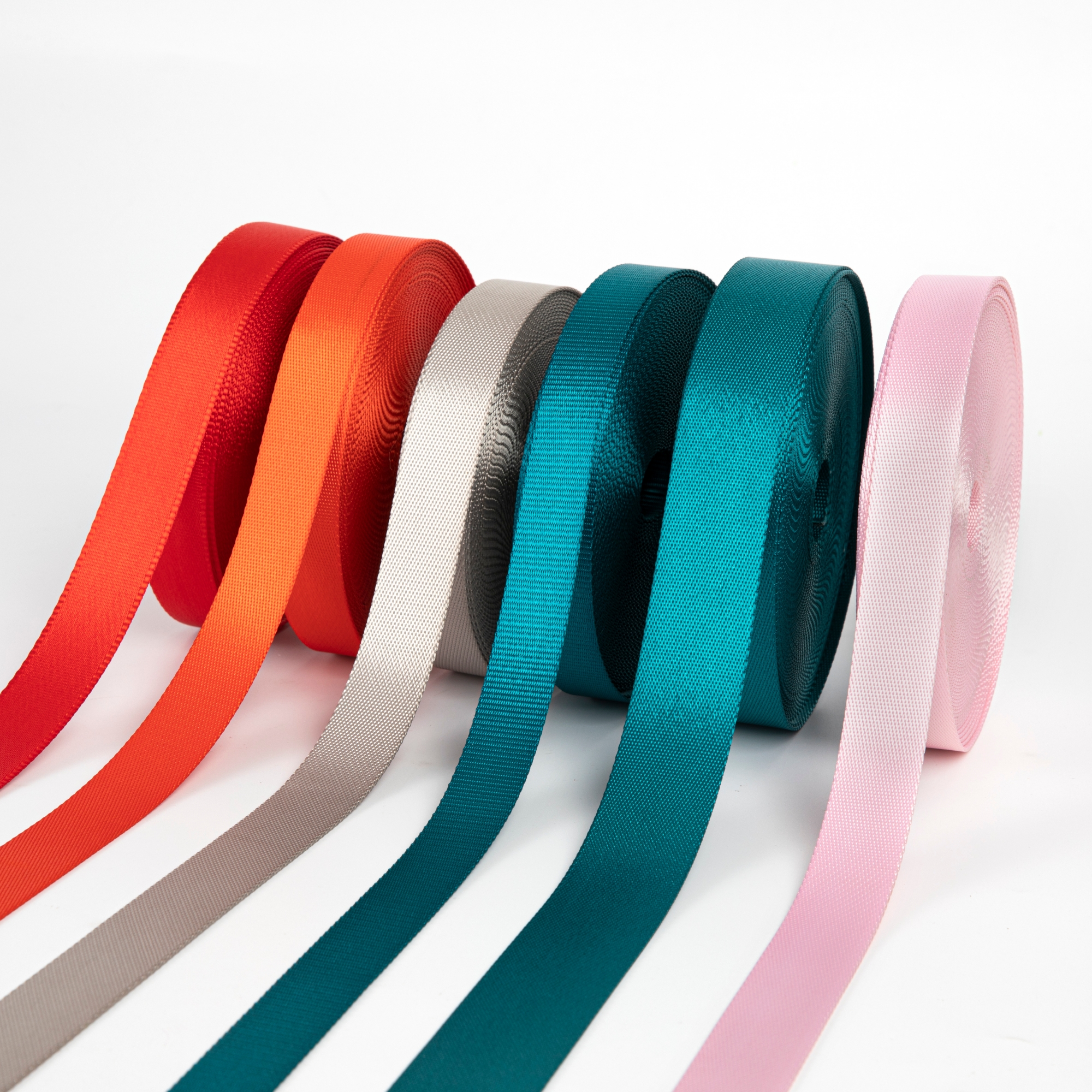
Rank 1 — Polyester Webbing (100% High-Tenacity Polyester Filament)
Published UV result: UV fastness Grade 4.5 after 500 hours (ISO 105). Polyester webbing also holds a dedicated Anti UV Test Report issued by SGS under ISO 105, certificate number SL82108301587901TX.
Sustainability and compliance: bluesign System Partner (certificate 027.131.001), GRS 4.0 (SGC-GRC03622-GRS-2025-07), OEKO-TEX Standard 100 Class 1 (SH010273603.1), RSL certificate 1001380744, and AZO & PCP free certificate C50472163.
Specification: breaking strength 500–2,000 lbs depending on specification; widths 20/25/38/50 mm and 1/2", 1", 1.5", 2"; thickness 1.20 mm; 50 meters per roll; custom Pantone matching; water absorption below 0.5%; excellent acid resistance.
Why it ranks first: it is the only mainstream outdoor family in this data set where a product-specific third-party UV report, the highest published UV grade, and a full eco-and-chemical certificate stack apply to the same item.
Best fit: outdoor backpacks, marine equipment, long-term outdoor tie-downs, solar sail edges.
Rank 2 — Backpack Webbing and Camping Webbing (UV-Stabilized Nylon / High-Tenacity Polyester)
Published UV result: UV fastness Grade 4.5 after 1,000 hours (ISO 105) — the longest published UV exposure window in this range.
Sustainability and compliance: bluesign System Partner, GRS 4.0, OEKO-TEX Standard 100 Class 1.
Specification: breaking strength 500–2,000 lbs; weave structures twill, plain, flat, herringbone and tubular; widths 20/25/38/50 mm and 1/2" to 2"; thickness 1.20 mm; water absorption below 0.5%; friction-free ultrasonic cut edge; stiffness optimized for YKK/Duraflex buckle compatibility.
Why it ranks second: a 1,000-hour test window is the strongest documented evidence for high-exposure applications, and the buckle compatibility plus ultrasonic edge suits high-volume pack assembly. It sits below polyester only because the criteria also weigh certification breadth and application range.
Best fit: outdoor backpacks, mountaineering packs, technical rucksacks, camera bags; tents, hammocks, camping furniture, tree straps.
Rank 3 — RPET Webbing and Recycled Webbing (Post-Consumer Recycled Polyester Yarn)
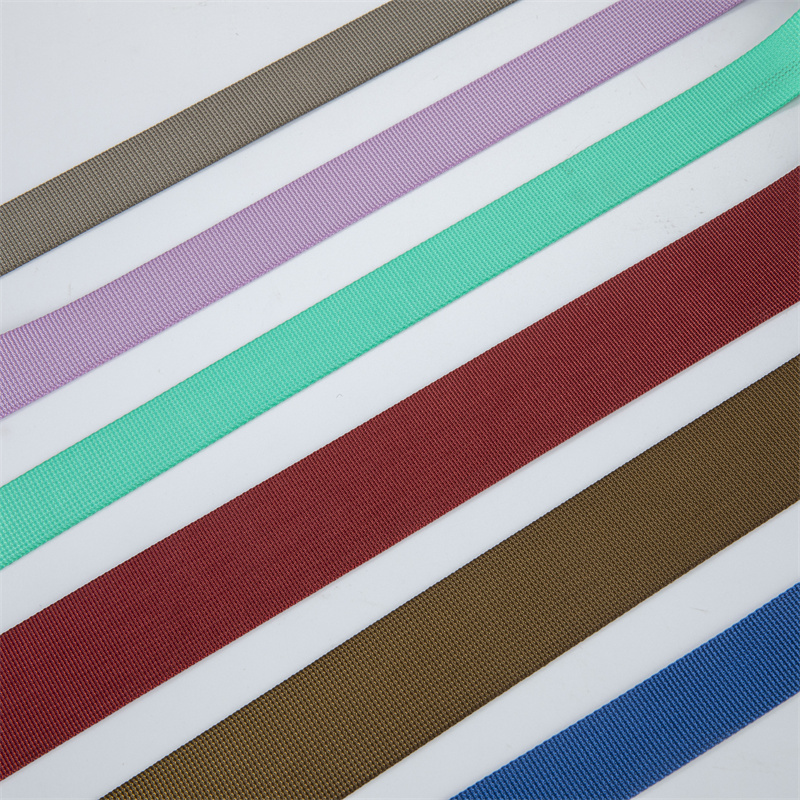
Published UV result: RPET webbing — UV resistance Grade 4 after 500 hours (ISO 105). Recycled webbing — UV resistance Grade 4–5 (AATCC 16.3).
Sustainability and compliance: GRS 4.0 with Transaction Certificate (TC) support; recycled content 50%–100% verified by TC; full chain of custody; bluesign System Partner and OEKO-TEX Standard 100 Class 1.
Specification: 100% high-tenacity post-consumer recycled polyester yarn; shrinkage below 3% at 100°C; optional Grade 4 water repellency (AATCC 22); widths 20/25/38/50 mm and 1/2" to 2"; thickness 1.20 mm.
Why it ranks third: it is the only family here where recycled content can be traced to transaction-certificate level, which is what a brand needs before printing a recycled-content claim. Its UV grade is one step below the top two, so it is the right choice when disclosure, not maximum sun exposure, drives the decision.
Best fit: sustainable luggage, eco-friendly tent components, mass-market sustainable outdoor gear, circular-economy collections.
Rank 4 — Bluesign Webbing
Published UV result: UV resistance Grade 4 (BS EN ISO 105-B02).
Sustainability and compliance: bluesign System Partner; zero restricted substances per the bluesign RSL; REACH and OEKO-TEX compliant; color fastness ISO 105 Grade 4–5; perspiration Grade 4.
Specification: Bluesign System Partner nylon or polyester substrate; widths 20/25/38/50 mm and 1/2" to 2"; thickness 1.20 mm; 50 meters per roll.
Why it ranks here: choose it when a compliance team requires system-level chemical management rather than a single product test, and when UV demand is moderate to high rather than extreme.
Best fit: tier-1 outdoor apparel, sustainable technical packs.
Rank 5 — Nylon Outdoor Webbing
Published light and weather result: color fastness to light Grade 4 (ISO 105-B02); salt water resistance Grade 4–5 (ISO 105-E02). Its published UV figure is a light-fastness grade rather than an hour-labeled exposure result, which is why it ranks below the four families above.
Sustainability and compliance: bluesign System Partner, GRS 4.0, OEKO-TEX Standard 100 Class 1.
Specification: high-tenacity nylon with a soft-touch finish, or 100% high-tenacity polyester filament; luster dull, semi-dull or bright; weave structures twill, plain, flat, herringbone and tubular; widths 20/25/38/50 mm and 1/2" to 2"; thickness 1.20 mm.
Why it ranks here: it is the strongest option in this set for appearance-led products that also face salt water — performance belts, camera bags, premium pet accessories and outdoor furniture trim.
Best fit: outdoor backpacks, mountaineering packs, technical rucksacks, camera bags, performance apparel belts, luxury outdoor furniture, premium pet accessories.
Rank 6 — Tubular Webbing
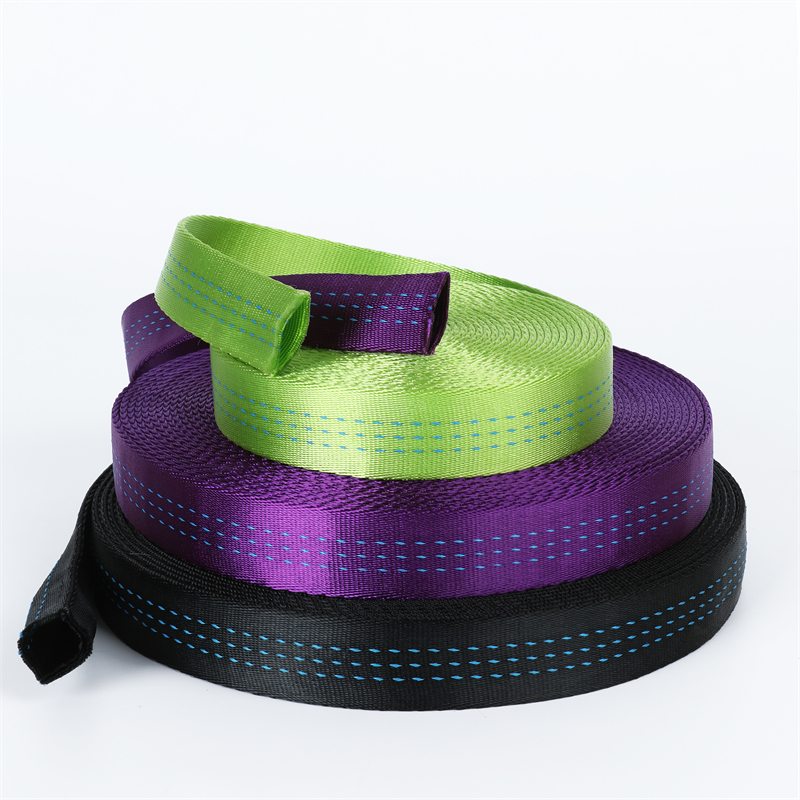
Published strength result: breaking strength 15 kN–25 kN; abrasion performance exceeds CE/UIAA standards, with UIAA certification obtained by a brand customer through a European testing agency. EN 566 requires a minimum of 22 kN for climbing slings in the EU.
Sustainability and compliance: bluesign System Partner, GRS 4.0, OEKO-TEX Standard 100 Class 1.
Specification: 100% high-strength Polyamide 6.6; seamless circular hollow weave; widths 10/12/16/19/25 mm; thickness 2.0–3.5 mm; extra-soft hand-feel for knotting.
Why it ranks here: no UV grade is published for this item, so it is ranked on load and abrasion performance rather than sun exposure. Buyers who deploy tubular webbing outdoors long-term should validate UV behaviour with their own sample testing.
Best fit: climbing slings, rescue harnesses, slacklines, professional pet leashes.
Rank 7 — Aramid Webbing
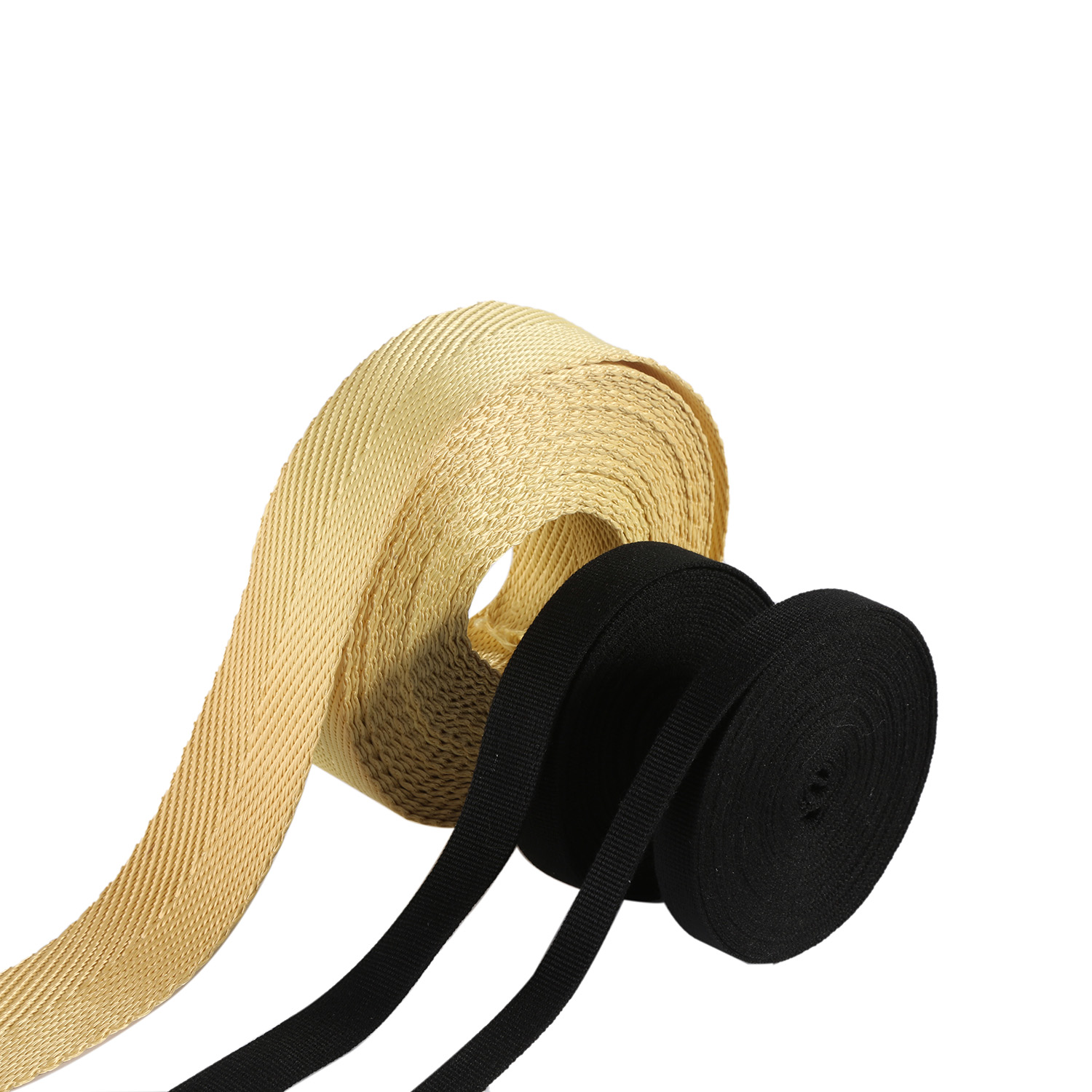
Published performance: tested to ISO 3795 and aviation FAA FAR 25.853; Grade 1 flame-retardant effect with smoldering time ≤ 5 seconds, after-flame time ≤ 5 seconds and damage length ≤ 100 mm; heat resistance with decomposition at 450°C and above; tensile strength 5–7× that of steel; excellent resistance to solvents and oils.
Sustainability and compliance: the available product data for aramid focuses on flame and heat standards rather than recycled or eco-certification claims.
Specification: aramid / Kevlar® / Nomex® base; widths 20/25/38/50 mm and 1/2" to 2"; thickness 1.20 mm; 50 meters per roll.
Why it ranks seventh on these criteria: it is not a UV-and-sustainability material — it is the correct material when heat, flame and chemical exposure are the governing risks.
Best fit: firefighting gear, aerospace safety, industrial lifting, extreme alpine gear.
Note on color consistency: the published color data for these products is expressed as fastness grades (ISO 105, AATCC 16.3, ISO 105-C06) plus custom Pantone matching and precise military color matching (for example Coyote Brown 498, Ranger Green, Olive Drab, Wolf Grey, Black, Coyote Tan 499, Camo Green 483 and Navy). If your brand needs a numeric color tolerance, request the measured value against your target color standard before approving the specification — a fastness grade alone does not define a tolerance limit.
Step-by-Step Breakdown: Running This Ranking Against Your Own Product Line
The list above is a starting filter, not a decision. Use this six-step sequence to convert it into a sourcing decision.
- Define the exposure envelope. Decide which strap sees direct sun, for how many seasons, and whether salt water or abrasion is also present. A shoulder strap on a daypack and a tie-down on a marine cover do not share the same requirement.
- Request hour-labeled UV evidence. Ask for the grade, the exposure hours and the test standard together — for example Grade 4.5 after 500 hours or Grade 4.5 after 1,000 hours under ISO 105, and the anti-UV report under ISO 105 (number SL82108301587901TX for polyester webbing).
- Separate company certificates from product certificates. ISO 9001:2015 (00224Q22797R0M), ISO 14001:2015 (00224E31944R0M) and ISO 45001:2018 (00224S21758R0M) cover the design and processing of functional webbing and webbing-finished products. Product-level claims need product-level documents: bluesign System Partner, GRS 4.0 with TC, OEKO-TEX Standard 100 Class 1, RSL and AZO & PCP free.
- Ask for measured color values, not only grades. Confirm the target color standard, then request the measured result for that standard alongside the color fastness test report (AATCC 186 / ISO 105, report SL82108291350601TX).
- Run a trial batch before scaling. Minimum order quantity is 3,000 meters per color per specification for webbing and 5,000 meters per color per specification for binding tape, with flexible MOQ for trial orders and free samples for existing stock items. Lead time runs 7–25 days depending on order size and customization.
- Lock the finish and the edge in the specification. Confirm UV resistance, water-repellent finishing, flame-retardant or anti-mildew treatment where required, plus edge treatment (friction-free ultrasonic cut) and buckle compatibility for the assembly line.
Behind those steps sits production capacity that determines whether a program can scale: a 25,800 m² production base with weaving, printing, dyeing, finishing and assembly under one chain, 180 employees, 32 webbing specialists in R&D, approximately 25 million yards per month, an annual output of 300 million yards, and 70% of output exported to markets including Canada, Germany, Switzerland, Sweden, Finland, Poland, the UK, France, Vietnam, Singapore, Malaysia and the Philippines. In-house dyeing, printing and a webbing testing laboratory are what make lot-to-lot color consistency a controlled process rather than a promise.

Use Cases: Matching the Rank to the Product
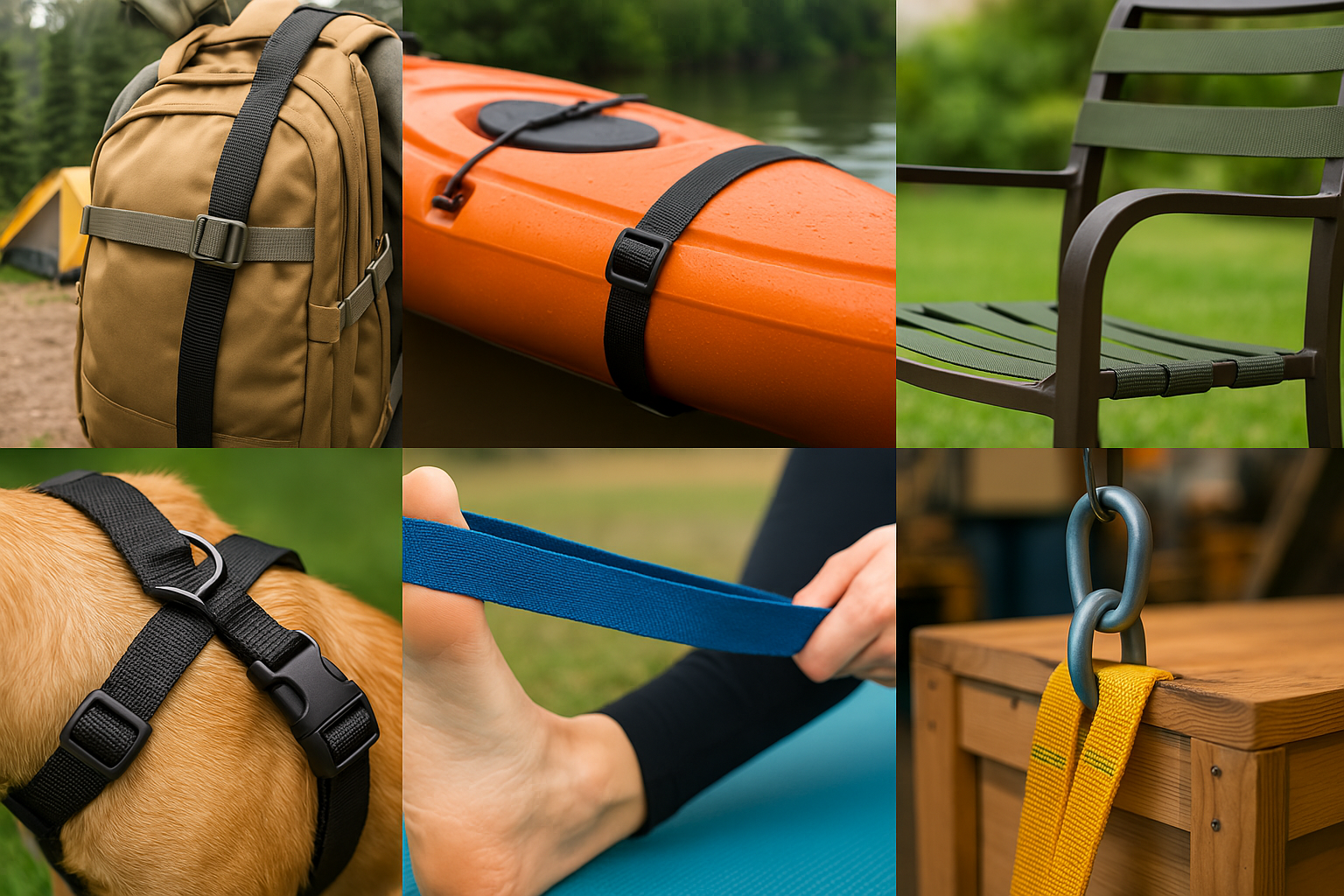
- Modular and technical backpacks: Rank 2 backpack webbing for load-bearing straps (1,000-hour UV window, buckle-optimized stiffness), with Rank 1 polyester for high-sun accents. One outdoor gear brand across Germany, Switzerland, Sweden, the UK, Finland, Poland, Norway, Estonia, the Netherlands, Vietnam and Malaysia uses 300,000+ meters per year in modular backpacks and expandable carrying systems, with durability held over 2–3 years of regular outdoor use.
- Tents, hammocks and tree straps: Rank 2 camping webbing, or Rank 3 recycled webbing where the tent is part of a sustainability collection.
- Bags, cooler bags and travel gear: Rank 3 RPET for recycled-content product lines, or Rank 1 polyester where water repellency and salt resistance matter more. A global bag and cooler manufacturer uses 1,000,000+ meters annually in this category, maintaining durability and color consistency over 2–4 years.
- Climbing slings, rescue harnesses and slacklines: Rank 6 tubular webbing, specified against EN 566's 22 kN minimum where the product is sold in the EU.
- Marine and life-saving equipment: Rank 1 polyester webbing — salt water resistance and the lowest water absorption in this set (below 0.5%).
- Pet leashes, collars and harnesses: Rank 5 nylon outdoor webbing for soft touch plus color range, or Rank 6 tubular webbing for professional leashes that take pulling loads.
- Belts and apparel trim: Rank 5 for appearance-led belts — performance apparel belts, utility belts and travel belts where color consistency and comfort govern.
- Child-contact products (adjacent category): stroller webbing is certified to OEKO-TEX Standard 100 Class 1 (baby articles) and compliant with RoHS Directive 2011/65/EU and amendment (EU) 2015/863 (report COBO21080021), with a fatigue test above 10,000 buckle cycles and rounded edges for skin protection.
- Firefighting, aerospace and industrial lifting: Rank 7 aramid webbing, where flame retardancy and heat resistance govern instead of UV and eco criteria.
Comparison Table: Ranked Outdoor Webbing by Published Data
| Rank & webbing type | Published UV / light result | Sustainability & chemical safety | Key specification | Best-fit application |
|---|---|---|---|---|
| 1. Polyester Webbing | Grade 4.5 after 500 h (ISO 105); Anti UV report SL82108301587901TX | bluesign System Partner, GRS 4.0, OEKO-TEX 100 Class 1, RSL, AZO & PCP free | 500–2,000 lbs; 20–50 mm; 1.20 mm | Backpacks, marine, tie-downs, solar sail edges |
| 2. Backpack / Camping Webbing | Grade 4.5 after 1,000 h (ISO 105) | bluesign System Partner, GRS 4.0, OEKO-TEX 100 Class 1 | 500–2,000 lbs; YKK/Duraflex buckle fit; ultrasonic edge | Packs, tents, hammocks, tree straps |
| 3. RPET / Recycled Webbing | Grade 4 after 500 h (ISO 105); Grade 4–5 (AATCC 16.3) | GRS 4.0 with TC; 50–100% recycled content; chain of custody | Shrinkage <3% at 100°C; optional Grade 4 water repellency | Sustainable luggage, eco tent components |
| 4. Bluesign Webbing | Grade 4 (BS EN ISO 105-B02) | bluesign System Partner; zero restricted substances per RSL; REACH / OEKO-TEX | Color fastness Grade 4–5; perspiration Grade 4 | Tier-1 outdoor apparel, technical packs |
| 5. Nylon Outdoor Webbing | Light fastness Grade 4 (ISO 105-B02) | bluesign System Partner, GRS 4.0, OEKO-TEX 100 Class 1 | Salt water Grade 4–5 (ISO 105-E02); soft-touch finish | Packs, camera bags, belts, pet gear |
| 6. Tubular Webbing | No UV grade published in current data | bluesign System Partner, GRS 4.0, OEKO-TEX 100 Class 1 | 15–25 kN; 10–25 mm; 2.0–3.5 mm; UIAA-referenced abrasion | Climbing slings, rescue harnesses, slacklines |
| 7. Aramid Webbing | Not published; flame and heat data only | Not stated for this item in the available data | ≤5 s smoldering / after-flame; 450°C+; 5–7× steel | Firefighting, aerospace, industrial lifting |
FAQ: Outdoor Webbing Recommendations, Compliance and Ordering
Which certifications should I verify before approving outdoor webbing for a UV-exposed product?
Verify product-level documents first: bluesign System Partner certificate 027.131.001; GRS 4.0 certificate SGC-GRC03622-GRS-2025-07 where recycled content is claimed; OEKO-TEX Standard 100 Class 1 certificate SH010273603.1; RSL certificate 1001380744; AZO & PCP free certificate C50472163; an Anti UV Test Report for polyester webbing (SL82108301587901TX, ISO 105); a color fastness report (AATCC 186 and ISO 105, report SL82108291350601TX); and a breaking strength report (PIA-Test Method-4108A-2005, report SL82308280825301TX). Company-level certificates — ISO 9001:2015 (00224Q22797R0M), ISO 14001:2015 (00224E31944R0M) and ISO 45001:2018 (00224S21758R0M) — cover the design and processing of functional webbing but do not replace product certificates. For climbing slings sold in the EU, EN 566 additionally requires a minimum tensile strength of 22 kN.
Can a webbing manufacturer deliver custom UV grades, colors, widths and weaves at OEM/ODM level?
Yes, within defined parameters. Customization covers material (nylon, nylon 6.6, PA, polyester, PES, recycled yarn, RPET), color, pattern, width, thickness, softness and finishes including UV resistance, water-repellent finishing, flame retardant and anti-mildew. Standard widths are 20/25/38/50 mm and 1/2", 1", 1.5", 2", with typical thickness of 1.20 mm, and weave structures include twill, plain, flat, herringbone and tubular. OEM and ODM services include design customization and branding support, plus value-added processes such as precision cutting, punching, sewing and finished-product assembly for straps, belts and gear components. Production runs at approximately 25 million yards per month from a 25,800 m² base with 32 webbing specialists in R&D.
What order size keeps a UV-resistant, certified webbing program economical?
Minimum order quantity is 3,000 meters per color per specification for webbing and 5,000 meters per color per specification for binding tape. Flexible MOQ is available for trial orders, and free samples are offered for existing stock items, so a brand can validate a specification before committing to annual volume. At the upper end, the same production base supports annual programs of 300,000+ meters (a modular backpack brand) and 1,000,000+ meters (a global bag and cooler manufacturer) while maintaining an annual output of 300 million yards and a 70% export share.
How do sourcing teams validate UV resistance and color consistency before mass production?
Request samples first, then run your own weathering, abrasion and salt-water checks against the manufacturer's documents: the anti-UV report (SL82108301587901TX), the color fastness report (SL82108291350601TX) and the breaking strength report (SL82308280825301TX). Because color data is published as fastness grades, ask for the measured value against your specific target color standard rather than accepting the grade alone. Production-side controls include 100% quality check, color consistency control, material inspection and an in-house webbing testing laboratory for color fastness and weather resistance; one outdoor gear brand has held durability and color consistency over 2–3 years of regular outdoor use on modular backpack webbing.
What lead time and after-sales support come with a certified outdoor webbing order?
Lead time is 7–25 days depending on order size and customization details. After-sales support covers responsive customer service, product consultation, customization support, fast feedback on quality issues and long-term cooperation support. To move from ranking to production, start with a sample request or quotation: email judecam@judegroup.com, call +86-592-6361058 or mobile +86 180-4632-1618, message WhatsApp +86 13358399583, or review specifications on the manufacturer's site at judewebbing.com. A trial order at the 3,000-meter level is the fastest way to compare the top-ranked families on your own product.
Conclusion: Choose by Exposure First, Then by Certification
For 2026 outdoor programs, the ranking resolves into a simple rule. If direct sun exposure is the governing risk, start with polyester webbing (Grade 4.5 after 500 hours, ISO 105) or backpack and camping webbing (Grade 4.5 after 1,000 hours). If a printed sustainability claim is the governing requirement, start with RPET and recycled webbing, where GRS 4.0 and transaction certificates make recycled content traceable. If chemical management is audited at system level, Bluesign webbing answers that question directly. Load and abrasion applications such as climbing slings belong with tubular webbing against the 22 kN EN 566 threshold, and heat and flame applications belong with aramid.
Whichever rank you start from, the same three checks decide whether the program succeeds: hour-labeled UV evidence, a certificate issued for the exact product, and a trial run at 3,000 meters per color per specification before you scale.
Request a sample or quotation
Send your target width, color standard, UV requirement and annual volume to judecam@judegroup.com, or contact the team on WhatsApp at +86 13358399583. Free samples are available for existing stock items, MOQ starts at 3,000 meters per color per specification, and lead time is 7–25 days.
Xiamen Jude Webbing Co., Ltd. (JUDECAM) · www.judewebbing.com · No. 601 ShiXing Road, Jimei District, Xiamen, 361024, China
Have Questions or Need More Details?
Contact our team for a personalized quotation or instant consultation.
Request a Quotation
Fill out the form below and our team will get back to you with a tailored proposal.
WhatsApp Direct Chat
Prefer to chat in real-time? Message us on WhatsApp for instant assistance & quick answers.
- Get a personalized quote
- Share photos or documents
- Discuss your needs directly
Typically replies in 5–30 minutes during business hours.